A standard 20-by-20-foot garage slab runs $5,000 to $8,000 installed by a GTA subcontractor, materials and labour included, according to 2AZ Group. Compare Paving Contractors publishes a rate instead, $26 to $31 per square foot. Shed pads run $15 to $25 per square foot (Nice Guy Concrete), and a full basement floor tear-out and re-pour stacks to about $34 per square foot and up on Strong Basements' own line items.
What does a garage pad, shed pad or slab cost?
Every figure below is quoted from the page it names. These 12 rows rest on 5 independent Canadian sources, each linked on the row it carries. Where sources disagree, each row keeps one publisher's own published figure rather than a range assembled across several, so you can check any number against the sentence it came from.
Researched July 2026, every figure re-checked against its source on August 28, 2026. CAD, sources named per row. Add 13% HST unless noted.
Item
Typical range
Unit
Source
Garage slab, standard 20x20, subcontractor-installed2AZ Group's subcontractor rate table, installed prices including materials and labour. It says the wide range reflects straightforward pours on easy sites against complex work with access issues, slopes or engineering requirements. The per-square-foot figure this guide used to show was not published by 2AZ; it was this total divided by 400 sq ft.
Garage slab, contractor-installed (published slab rate)Compare Paving Contractors' own published slab rate. The same page prices an insulated-formwork slab lower, from $15 per sq ft, and notes a garage slab averages about 6 inches thick. It stresses that contractors, not materials, drive most of the variation, so compare several quotes.
Basic broom-finish concrete pad, Ontario benchmark (5–7" with A-gravel base)An Ontario average, not a Toronto figure. The Art of Concrete says a 100 sq ft project runs $2,500 to $5,000 because the per-square-foot price is higher on small jobs, and that a no-frills broom-finished pad typically starts around $20 per square foot.
Shed pad, 4–5" slab incl. excavation, compacted gravel and meshNice Guy Concrete says this includes excavation, gravel base, reinforcement and concrete installation, and that the figure depends on size, thickness and site conditions.
$15–$25(typ. $1,800–$3,000 for a 10'×12' (120 sq ft) pad)
Basement/garage interior floor pour only (4" basement at 32 MPa; 6" garage)Both figures are open-ended floors, not ranges: Strong Basements writes starts at $10+ for a 4-inch basement slab and $15+ for a 6-inch garage slab. Pour only, with removal, gravel, insulation and reinforcement all priced separately.
Existing floor removal + excavation (before re-pour)Open-ended floors. Strong Basements writes starts at $14+ for a standard 7-inch basement excavation and $20+ for a 10-inch garage depth, the garage being dearer because it means demolishing a 6-inch slab heavily reinforced with rebar. The $10 floor this guide used to show is not on their page.
Gravel bedding base, 5" compactedA flat rate, not a range: Strong Basements charges $5 per sq ft for a 5-inch gravel bed in both basements and garages.
Rigid foam under-slab insulation add-on, 2"Open-ended: Strong Basements lists $4+ per sq ft for 2-inch R10 rigid foam, and lists slab insulation as not applicable in a garage. The $6 ceiling this guide used to show is not on their page; thicker sheets run to R20 at 4 inches and cost more.
Vapour barrier, 10-mil poly (material only)Material only, sold by the roll. 2AZ Group's own listing is for 10 mil poly, not the 6 mil this guide previously named.
Reinforcement add-on: wire mesh vs rebar gridTwo different specs, not a range: Strong Basements charges $1 per sq ft for welded steel wire mesh in a basement and $8+ per sq ft for a 10mm steel rebar mesh in a garage. The $2 floor this guide used to show is not on their page.
Ready-mix concrete delivered, 25–32 MPa residential mixPlant-gate prices with standard delivery inside a 30 km radius; 2AZ Group adds $8 to $15 per kilometre beyond that. The span covers two mixes: 25 MPa general purpose at $250 to $290 and 32 MPa high-strength at $290 to $350.
Concrete pump truck for tight-access pours (rear-lane garages, basements)2AZ Group's GTA equipment rental rate. A trailer-mounted line pump is listed at the same $800 to $1,200.
Every band below is one publisher's own concrete slab figure, drawn to scale from the same rows as the table. Bars are grouped by the unit the publisher used, because a square-foot rate and a whole-project price do not belong on one axis.
per sq ft installed
Basic broom-finish concrete pad, Ontario benchmark (5–7" with A-gravel base)$15–$30
The Art of Concrete (Kitchener, ON, Jan 2025)
Shed pad, 4–5" slab incl. excavation, compacted gravel and mesh$15–$25
6 of these 12 rows are drawn. The other 6 are priced in a unit no other row on this page shares, or carry an open-ended figure such as a “starting at” price with no published ceiling. Neither can be placed on a shared axis honestly, so they stay in the table above with their sources rather than being drawn to a number nobody printed.
What are you actually buying?
Two quotes on the same job often differ because they are quoting different work, not different rates. This is how the trade splits it up, drawn from the rows and factors already on this page. It carries no prices on purpose: those belong beside the source that published them.
What is under a finished slab
Most of what a slab costs is buried before the concrete arrives. Every layer here is a line this page prices separately, which is why two slab quotes can differ without either being wrong.
Excavation, down to undisturbed ground
Existing floor out, soil dug to depth. Wet, sloped or previously disturbed ground is corrected here or it shows up in the slab later.
Compacted granular base
Crushed stone, laid and compacted. Depth and compaction of this layer, not the slab above it, are what stop a pad settling.
Vapour barrier, and insulation where it applies
Sheet poly to keep ground moisture out of the slab, and rigid foam under heated space. Both are add-ons on most quotes rather than assumed.
Reinforcement
Welded wire mesh or a rebar grid. Rebar is the standard for a pad carrying vehicles, and it is a materially different price from mesh.
The pour, at a thickness matched to the load
A shed pad and a garage pad are not the same slab. Thickness and mix strength both step up where vehicles go, and a thicker slab needs proportionally more concrete.
Finish
Broom finish is the baseline. A decorative or coated surface is priced on top of a slab that is otherwise identical.
Read top down, the way the assembly is built up from the ground.
What does this work look like across the Greater Toronto Area?
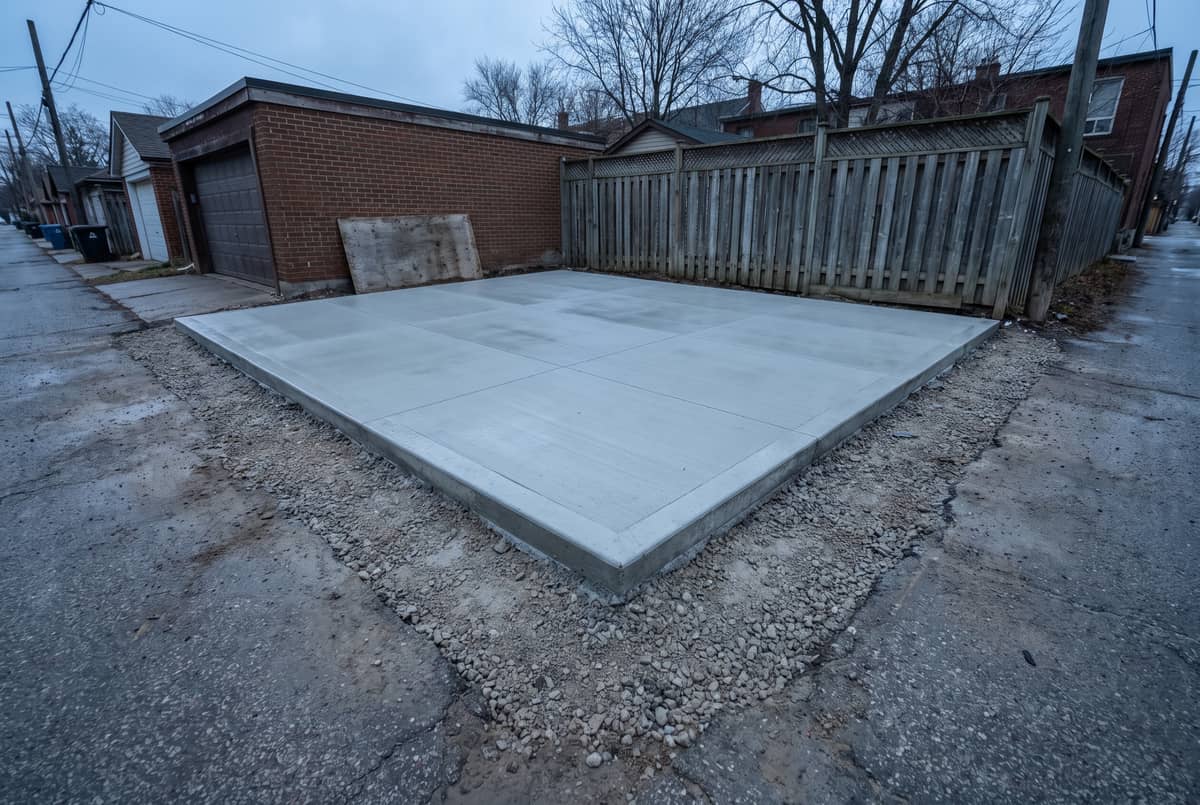
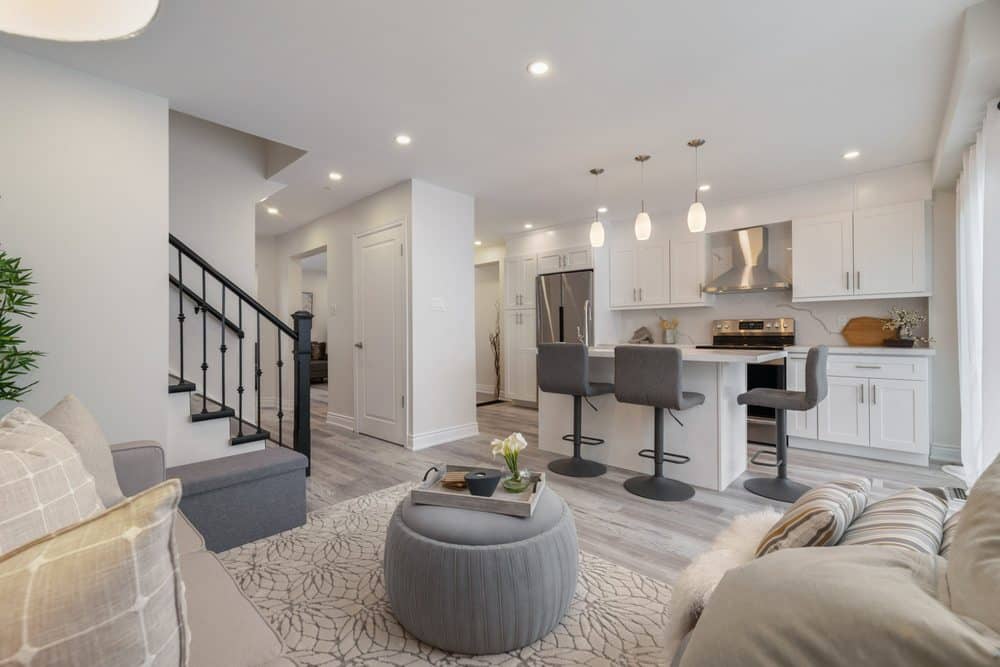
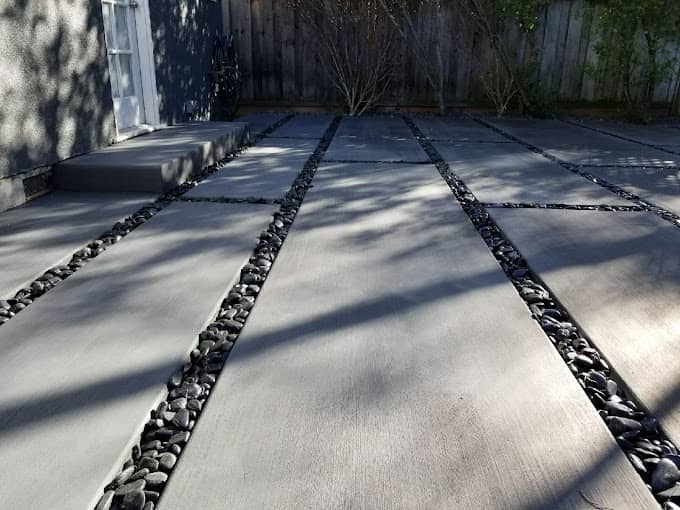
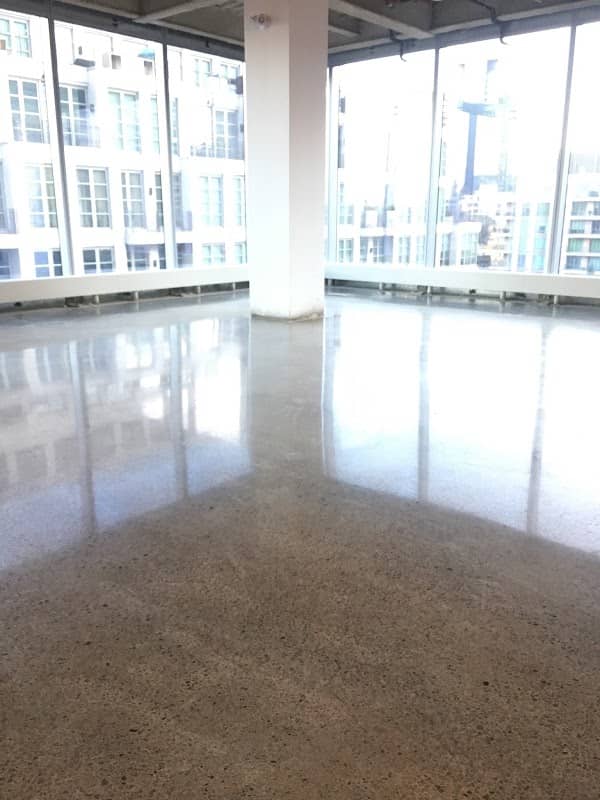
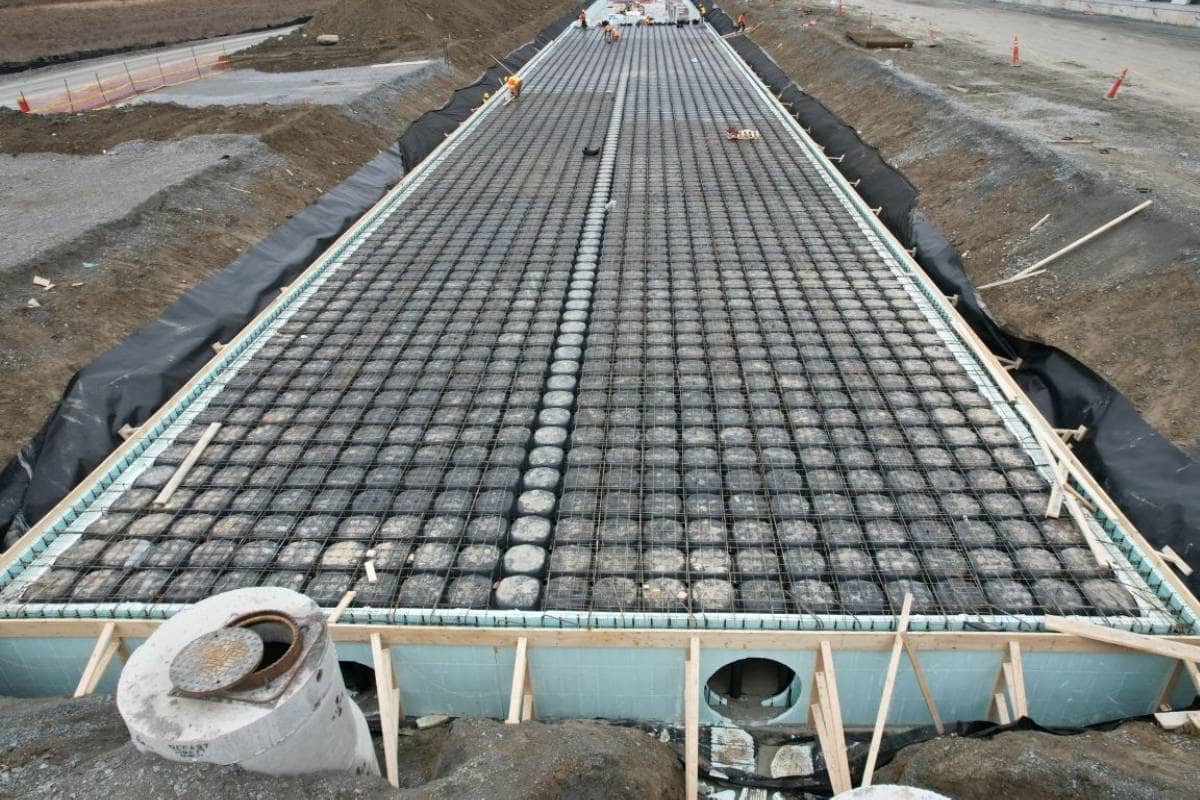
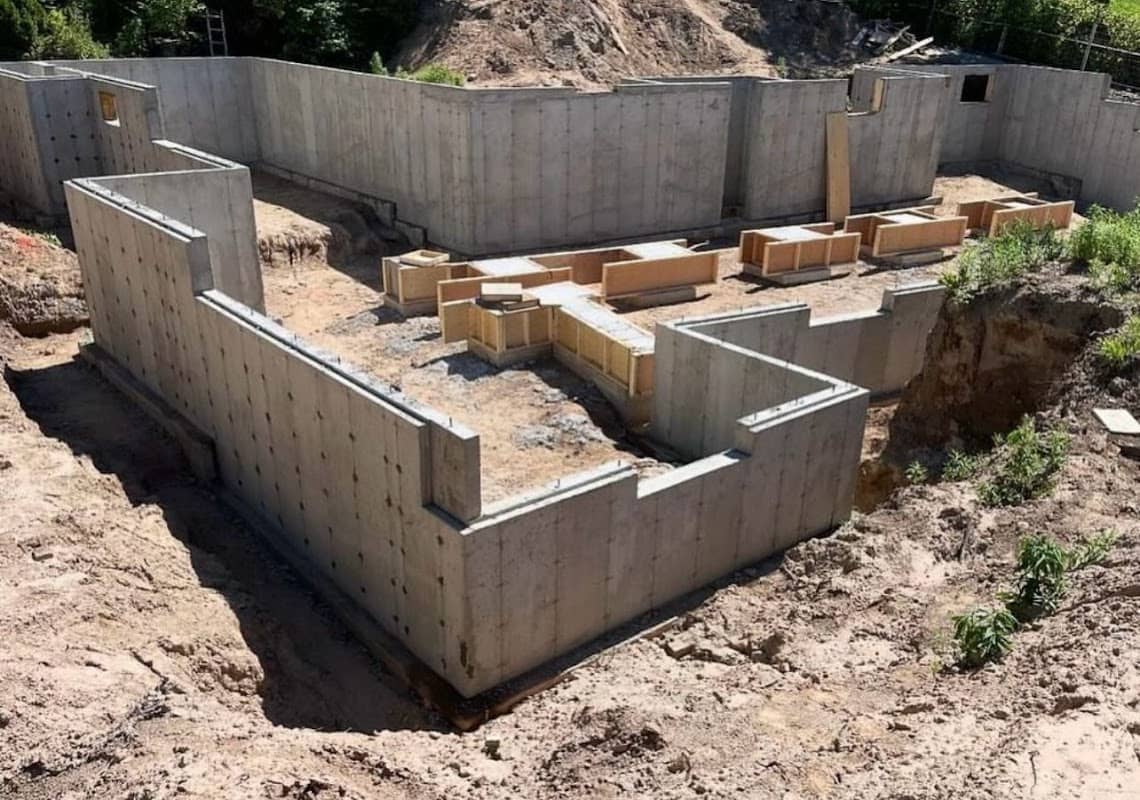
A rate per square foot is hard to picture. These are photographs published by ConcreteFinder companies working in this category across the Greater Toronto Area, at the size they deserve rather than as thumbnails. Each one links to that company's record, with its rating, its service area and its phone number.
Each photograph was published by the company shown, not chosen to sell a finish. Photographs that state a credential, a rating or an offer in the picture are excluded from this site.
What drives the price?
Spec, access and job size move concrete slab pricing more than anything else in Toronto. Each factor below is tied to a figure in the table above, so you can read a quote and see where the money goes.
Slab thickness and mix strength: 4" for sheds and basement floors vs 5–6" at 32 MPa for garage pads that carry vehicles - a 6" slab needs ~50% more ready-mix than 4"
Access: rear-laneway garage pads or basement pours with no truck access add a pump truck ($800–$1,200) or wheelbarrow labour hours
Base condition: excavation depth (8–12" typical), Granular A tonnage ($35–$50/tonne), and corrections for wet, sloped or disturbed soil
Reinforcement choice: welded wire mesh ($1/sq ft in a basement) against a 10mm rebar mesh ($8+/sq ft in a garage), per Strong Basements - rebar is standard for garage pads
Demolition: breaking out and disposing of an existing slab starts at $14/sq ft for a basement and $20/sq ft for a garage before any new work begins
Finish level: broom finish is the baseline; exposed aggregate or stamped finishes push pads to $20–$40/sq ft; epoxy coating adds $3–$10/sq ft
Season: heated ready-mix surcharge of $20–$40/m³ from November to March, plus hoarding/heating costs on winter pours
Insulation and moisture add-ons: 2" rigid foam from $4/sq ft; 10-mil poly vapour barrier $80-$120 per 1,000 sq ft roll (material)
What's specific to Ontario and Toronto?
Yes, Ontario changes the math: 13% HST sits on top of every quote, City permits apply to anything touching the right-of-way, and the freeze-thaw season closes the practical pour window. Each point below is what applies locally.
Permits: a detached garage or any accessory structure over 10 m² (107 sq ft) needs a City of Toronto building permit; sheds under 15 m² (161 sq ft) are exempt from a permit but must still comply with the Zoning Bylaw. Garage-project permit fees start around $220 (Toronto General Contractors, 2025).
Front-yard parking pads: many central wards (for example areas south of Bloor, and Riverdale) have moratoriums on new pads. Legal pads pay the City $514.41 + HST to apply, $331.13 + HST in annual renewal and $165.56 + HST to transfer on sale (City of Toronto 2026 fee schedule). Any work touching the boulevard, sidewalk or curb needs a right-of-way street work permit, and Toronto only issues those to licensed contractors; at least 75% of the remaining front yard must stay soft landscaping.
Basement underpinning (floor lowering) is a permit-and-engineering job, not just a concrete pour: engineer-stamped drawings are mandatory with P.Eng field review at first and final stages. Strong Basements publishes $350–$480 per linear foot for the structural work, ~$80–$105/sq ft for complete lowering projects, engineering drawings $2,000–$5,000, city permit ~$400 direct (contractors quote $1,000–$3,000 with admin), and ~$15/sq ft for the new slab within the project.
HST: Ontario contractors quote before tax - add 13% HST to every figure in this guide. There is no rebate for repairing or replacing a pad or slab; the HST new-housing/substantial-renovation rebate only applies to major whole-home renovations meeting CRA tests.
Seasonality: the practical residential pour season in the GTA is roughly April to November. Ready-mix suppliers add a $20–$40/m³ heated-concrete surcharge from November to March (2AZ Group), and cold-weather pours need hoarding, heaters and accelerating admixtures, so winter exterior flatwork costs more and many contractors simply pause it.
Ontario Building Code: under-slab insulation is not required for basement floors (unlike basement walls), but 6-mil polyethylene is the standard vapour/moisture layer under new slabs and R-10 rigid foam is recommended when installing in-floor heating (TrueForm Reno OBC guide; OBC vapour barrier sections).
How can I pay less?
The biggest savings come from job timing, bundling small pours into one mobilization, and doing demolition yourself. Each lever below is tied to a real number in the table above, not to cutting the parts that matter.
Get three itemized quotes and compare specs, not totals - the gap between 2AZ Group's $5,000-$8,000 subcontractor total for a 20x20 slab and Compare Paving Contractors' $26-$31/sq ft rate is mostly thickness, insulation and reinforcement differences hidden in the fine print.
Confirm the quote includes excavation, gravel base, disposal and forming; 'pour only' pricing (from $10/sq ft) can double once site prep is added.
Book mid-season (May–October): you avoid the $20–$40/m³ winter concrete surcharge and hoarding/heating charges, and crews aren't charging rush premiums.
For a shed under 15 m² you don't need a Toronto building permit - keep it under that threshold and you save both the fee and drawings.
If your lot has truck access, let the ready-mix truck chute directly instead of paying $800–$1,200 for a pump.
Combine small pours: contractors carry minimum charges and part-load ready-mix fees, so pouring the shed pad and walkway on the same day is cheaper than two visits.
Skip decorative finishes on utility slabs - broom finish (~$20/sq ft installed in Ontario) vs stamped/exposed aggregate ($20–$40/sq ft) is the single biggest optional cost swing.
How did we research these numbers?
Every price on this page was re-opened at its source and matched to the sentence that carries it. Where sources disagree, ConcreteFinder keeps each row on one publisher's own figure and writes the disagreement down here rather than blending them into a range nobody published.
Installed garage-slab pricing conflicts widely between sources. 2AZ Group publishes a GTA subcontractor total of $5,000-$8,000 for a standard 20x20 slab; Compare Paving Contractors publishes a rate of $26-$31/sq ft. Neither publishes the other's unit, so each row now carries the figure its own source states rather than a conversion. Spec drives the gap: thickness, insulation under the slab, rebar against mesh, and whether excavation and disposal are in the quote.
2AZ Group's $3,090–$4,340 '20×20 garage slab' figure is a materials-plus-labour cost breakdown, not a retail quote; the same source lists $5,000–$8,000 as the realistic subcontractor-installed price. Retail quotes from established Toronto firms trend higher again.
The Art of Concrete's $15–$30/sq ft benchmark is published from Kitchener-Waterloo; Toronto-proper quotes typically land mid-to-upper range due to higher labour rates and lane-access complications.
Small jobs carry a per-square-foot premium: a 10'×12' shed pad still costs $1,800–$3,000 because mobilization, forming and a ready-mix minimum load are fixed costs regardless of size.
Basement floor 'pour only' pricing (from $10/sq ft) is misleading for full replacements. Stacking Strong Basements' own line items for a basement (removal from $14 + gravel $5 + insulation from $4 + wire mesh $1 + pour from $10) puts a complete tear-out and re-pour at roughly $34/sq ft and up, since four of those five are open-ended floors rather than ceilings.
All figures are CAD from Canadian publishers. US guides surfaced in search (HomeGuide, Angi, HomeAdvisor, Modernize) were excluded rather than converted because their labour bases don't map to GTA rates. HomeStars' Canadian slab guide could not be verified directly (page blocked) and is not used in price rows.
Source freshness: 2AZ Group (early 2026) and Strong Basements (live 2026 pages) are current; The Art of Concrete is Jan 2025; Compare Paving Contractors is Apr 2024, the oldest source, so its $26-$31/sq ft may now be modestly understated.
ConcreteFinder tracks 10 concrete slab contractors across the Greater Toronto Area, rated 4.87★ on average. The three below rank highest on our review-weighted score, based on ConcreteFinder's analysis of 10 GTA businesses, July 2026.
3 of 4 details on file · Pours in Whitby as a concrete contractor, 19 Google reviews average 4.8★, also listed under garage pads & slabs and foundations & underpinning.
3 of 4 details on file · Pours in Willowdale as a concrete contractor, 76 Google reviews average 5.0★, also listed under garage pads & slabs and concrete patios & walkways.
A quote is hard to compare when half of it is trade vocabulary. These are the terms used in the table above, defined in the words a contractor would use.
Vapour barrier
A polyethylene sheet laid under a slab to stop ground moisture rising through the concrete. Sold by the roll and priced as a material line, separate from the pour.
Welded wire mesh
A grid of steel wires laid in the slab to spread stress and hold cracks tight. It is the cheaper reinforcement; a tied rebar grid is the heavier option specified for garage floors carrying vehicles.
MPa
Megapascals, the compressive strength of a concrete mix. Ontario residential flatwork is normally 25 to 32 MPa; higher numbers cost more per cubic metre because they carry more cement.
Air-entrained concrete
A mix with microscopic air bubbles deliberately introduced so water has somewhere to expand when it freezes. It is the standard specification for exterior concrete in Toronto's freeze-thaw climate.
Granular base
The compacted crushed stone layer poured concrete sits on, usually Granular A. Depth and compaction of this layer, not the slab, are what stop a driveway or patio settling.
Which other costs should I check?
Most concrete slab quotes arrive alongside another one. These are the three ConcreteFinder guides closest to this job, each priced from its own named sources.
How much does a concrete garage pad cost in Toronto?
2AZ Group prices a standard 20x20 garage slab installed by a GTA subcontractor at $5,000 to $8,000, materials and labour included. Compare Paving Contractors publishes a rate instead, $26 to $31 per square foot for a concrete slab, and prices an insulated-formwork slab from $15 per square foot. Add 13% HST: contractors quote before tax.
How much does a concrete shed pad cost in the GTA?
GTA installers price shed pads at $15–$25 per square foot installed, so a common 10'×12' pad lands at $1,800–$3,000 (Nice Guy Concrete, Milton/Oakville/Mississauga). That includes 8–10 inches of excavation, 4–6 inches of compacted gravel, wire mesh and a 4–5 inch broom-finished slab. Sloped or tight-access yards push toward the top of the range.
What does it cost to re-pour a basement floor in Toronto?
Pouring a new 4-inch basement slab starts around $10 per square foot in Toronto (Strong Basements). A full replacement stacks up fast, and every line is a floor rather than a ceiling: removing the old floor starts at $14, 5-inch gravel bedding is $5, 2-inch rigid foam starts at $4 and welded wire mesh is $1. That is about $34 per square foot and up, so a 600 sq ft rebuild starts near $20,000.
Do I need a permit for a garage pad or shed pad in Toronto?
For garages, yes: any detached structure over 10 m2 (107 sq ft) needs a City of Toronto building permit, with fees starting around $220. Sheds under 15 m2 (161 sq ft) are exempt, though zoning still applies. Front-yard parking pads need a separate licence, $514.41 to apply plus $331.13 a year, both plus HST, and many central wards have moratoriums on new pads.
How thick should a concrete garage pad be?
Sheds need 4 inches; garage floors carrying vehicles should be 5 to 6 inches of 32 MPa concrete with rebar (Strong Basements builds 6-inch reinforced garage slabs). Thickness drives cost: a 10mm rebar mesh runs $8+ per square foot against $1 for welded wire mesh, and a 6-inch slab needs roughly 50% more ready-mix at $250 to $350 per cubic metre delivered.
Can you pour a concrete slab in winter in Toronto?
Yes, but it costs more and most contractors avoid it. GTA ready-mix suppliers add a $20–$40 per cubic metre heated-concrete surcharge from November to March (2AZ Group), and crews need hoarding, heaters and accelerating admixtures. The practical residential pour season is roughly April to November; a mid-season booking usually beats a rushed late-fall pour on price.
Is HST included in concrete quotes in Ontario?
Almost never - Ontario contractors quote before tax, so add 13% HST when comparing bids. A $6,500 garage pad quote actually costs $7,345; an $8,000 quote becomes $9,040. There's no HST rebate for replacing a pad or slab; the renovation rebate only applies to substantial whole-home projects meeting CRA tests. Get 'plus HST' confirmed in writing.
How much do under-slab insulation and a vapour barrier add?
Budget from $4 per square foot for 2-inch R10 rigid foam under the slab (Strong Basements) and $80 to $120 per 1,000 sq ft roll for 10-mil poly vapour barrier material (2AZ Group). The Ontario Building Code does not require insulation under basement floors, but it is strongly recommended with in-floor heating.
 1
1