A standard 20-by-20-foot garage slab runs $5,000 to $8,000 installed by a GTA subcontractor, materials and labour included, according to 2AZ Group. The concrete itself is $245 per cubic metre for 25 MPa and $255 for 30 MPa at the plant gate before delivery and HST (Canada Building Materials, January 2026). Labour drives the rest: GTA crews charge $35 to $55 an hour and budget 4 to 6 hours per cubic metre poured.
What does concrete work cost by material, labour and project?
Every figure below is quoted from the page it names. These 12 rows rest on 4 independent Canadian sources, each linked on the row it carries. Where sources disagree, each row keeps one publisher's own published figure rather than a range assembled across several, so you can check any number against the sentence it came from.
Researched July 2026, every figure re-checked against its source on August 28, 2026. CAD, sources named per row. Add 13% HST unless noted.
Item
Typical range
Unit
Source
Ready-mix concrete, 25 MPa strength mix, delivered (GTA plant price)A single published plant price, not a range, and it is before delivery charges, the $7.00/m3 environmental charge, a $2.00/m3 fuel surcharge and 13% HST. CBM's residential R3 25 MPa mix is $248 and its CSA C-4 25 MPa is $260. All prices rise by a $15.00/m3 escalator each January 1.
Ready-mix concrete, 30–35 MPa, delivered (GTA)Plant prices before delivery, surcharges and HST: $255 for 30 MPa and $270 for 35 MPa. Strengths above 35 MPa require a minimum load of 3 m3. The $350 ceiling this guide used to show is not on CBM's list.
Small-load delivery charge (partial truck, 1–4 m³)Charged per load and it rises as the load shrinks: $175 for 3.2 to 4 m3, $300 for 1.2 to 3 m3, $400 for a single cubic metre. The minimum load size is 1 m3, and one part load is allowed to finish a pour on orders over 7 m3.
Winter handling surcharge (Nov 1 – Apr 30)A flat charge, not a range: $22.00 per cubic metre on every load between November 1 and April 30 inclusive. Lightweight mixes carry a separate $30.00 winter charge. The $20 to $40 range this guide used to show is not on CBM's list.
Truck waiting/unloading time beyond 60 min included60 minutes per load is allowed for unloading; beyond that it is $2.00 a minute, which is the $120 hourly rate. A pour cancelled after noon the day before carries a minimum $600 charge.
Concrete line pump with operator (residential pours)Rockit says the rate depends on project duration, concrete volume and total hose length, and quotes each job on distance and mix. 2AZ Group prices a trailer-mounted line pump at $800 to $1,200 for a half day.
Boom pump with operator, 28 m to 42 m+ boomHalf-day rates, and the span covers two machine sizes: $1,200 to $1,800 for a 28 m to 36 m boom and $1,800 to $2,500 for 42 m and up. Pump trucks are booked separately from the ready-mix order.
Concrete finisher wage, Toronto Region (employee, not charge-out)An employee wage, not a contractor's charge-out rate. Job Bank's figures are for the Toronto Region over the 2023-2024 reference period, updated 19 November 2025, from Employment Insurance Survey data.
Contractor crew charge-out: finisher / formwork carpenter2AZ Group's GTA labour rate for a formwork carpenter. A concrete foreman is $45 to $65 an hour on the same list, and they budget 4 to 6 labour hours per cubic metre poured.
Garage slab, 20 ft x 20 ft, installed (subcontractor price)2AZ Group's subcontractor rate table, installed prices including materials and labour. The wide range reflects straightforward pours on easy sites against complex work with access issues, slopes or engineering requirements. A standard residential basement floor is $6,000 to $10,000 on the same table.
Rebar, 10M–15M, 20-ft barThe span covers two bar sizes: $8 to $12 for 10M and $12 to $18 for 15M, both in 20-foot lengths. 20M runs $18 to $28. 2AZ says rebar prices stabilised in late 2025.
Welded wire mesh, 4 ft x 8 ft sheet (6x6 W2.9)Material only, sold by the sheet. The $17 floor this guide used to show came from a retailer page that now blocks non-browser requests and could not be checked.
Every band below is one publisher's own concrete work figure, drawn to scale from the same rows as the table. Bars are grouped by the unit the publisher used, because a square-foot rate and a whole-project price do not belong on one axis.
2AZ Group - Real Cost of Concrete Work in the GTA 2026
Truck waiting/unloading time beyond 60 min included$120
Canada Building Materials (GTA price list, 2026)
6 of these 12 rows are drawn. The other 6 are priced in a unit no other row on this page shares, or carry an open-ended figure such as a “starting at” price with no published ceiling. Neither can be placed on a shared axis honestly, so they stay in the table above with their sources rather than being drawn to a number nobody printed.
What are you actually buying?
Two quotes on the same job often differ because they are quoting different work, not different rates. This is how the trade splits it up, drawn from the rows and factors already on this page. It carries no prices on purpose: those belong beside the source that published them.
Where the money goes: the concrete, and everything done to it
A ready-mix price and a finished-work price are two different numbers, and a quote that blurs them is hard to compare. The plant sells a cubic metre. The crew turns it into a slab.
Bought from the ready-mix plant
Mix strength, and whether it is air-entrained
Exterior work in Toronto needs an air-entrained mix. Each step up in strength costs more per cubic metre because it carries more cement.
Partial-load charge
Order less than about a full truck and the plant adds a per-load fee, which is why a small pour costs far more per cubic metre than a large one.
Winter handling
From November to April the plant heats its water and aggregate and bills for it, on top of whatever the site has to do to keep the pour warm.
Delivery beyond the included radius
Delivery is normally included inside a set distance of the batch plant. Past it, the kilometres are billed.
Charged by the crew on site
Forming, pouring and finishing
The hours themselves. Complex forms, steps and decorative finishes push them up sharply over a plain rectangle.
A pump, when the truck cannot reach
Backyards, laneway garages and pours over a house mean the concrete is pumped rather than chuted, and the pump is its own line on the quote.
Demolition and disposal
Breaking out the old surface and getting it off the property, bin included. Quoted separately often enough that it is worth asking.
Waiting time on the truck
A fixed unloading window comes with the load. A crew that runs past it pays the mixer to sit there, and that lands on your invoice.
What does this work look like across the Greater Toronto Area?
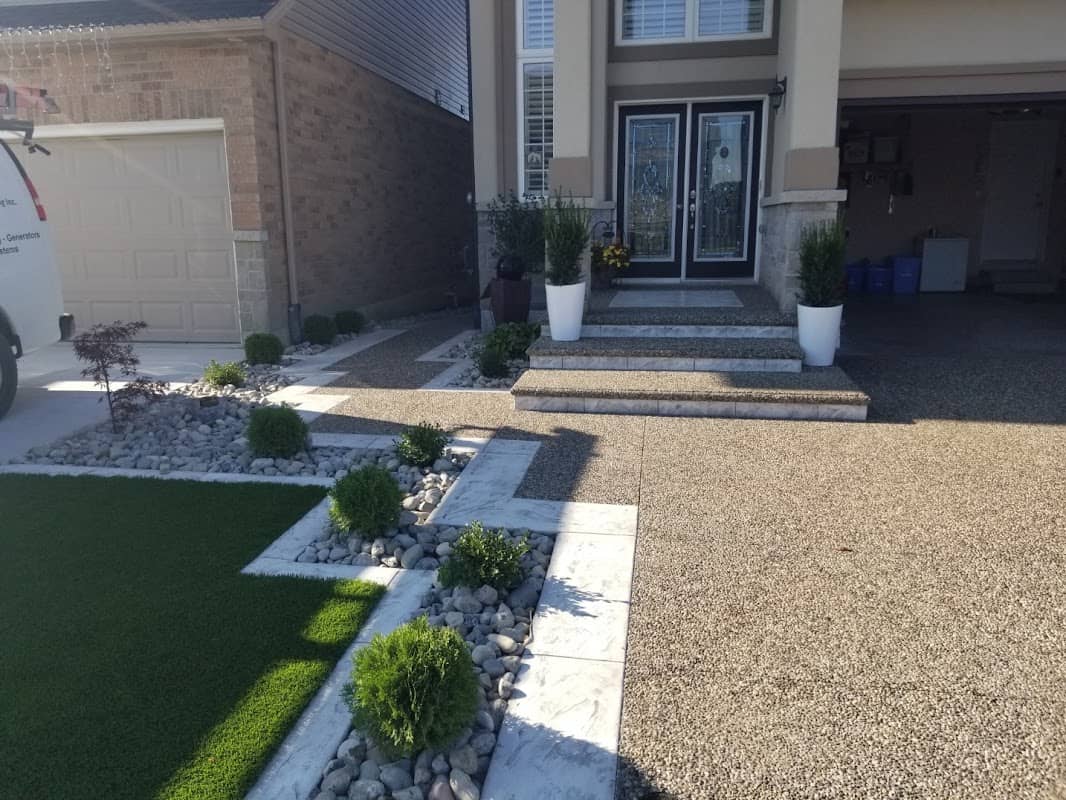
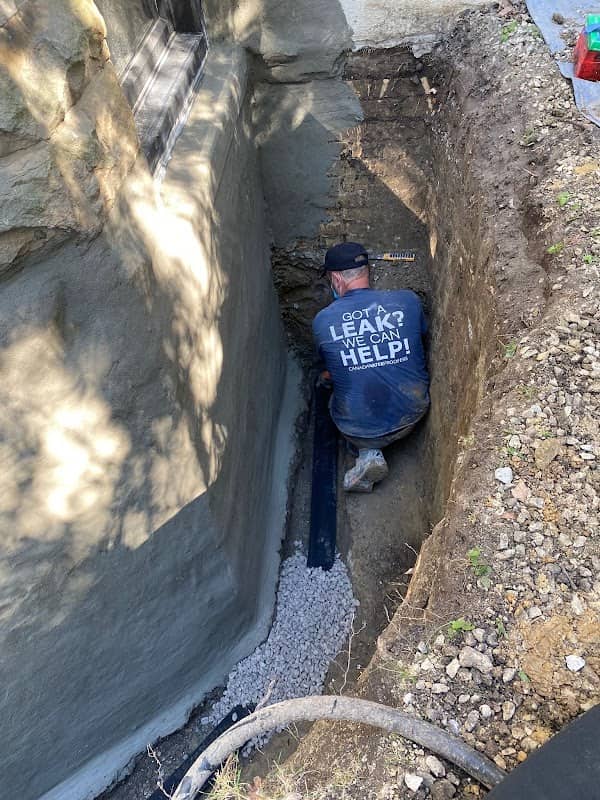
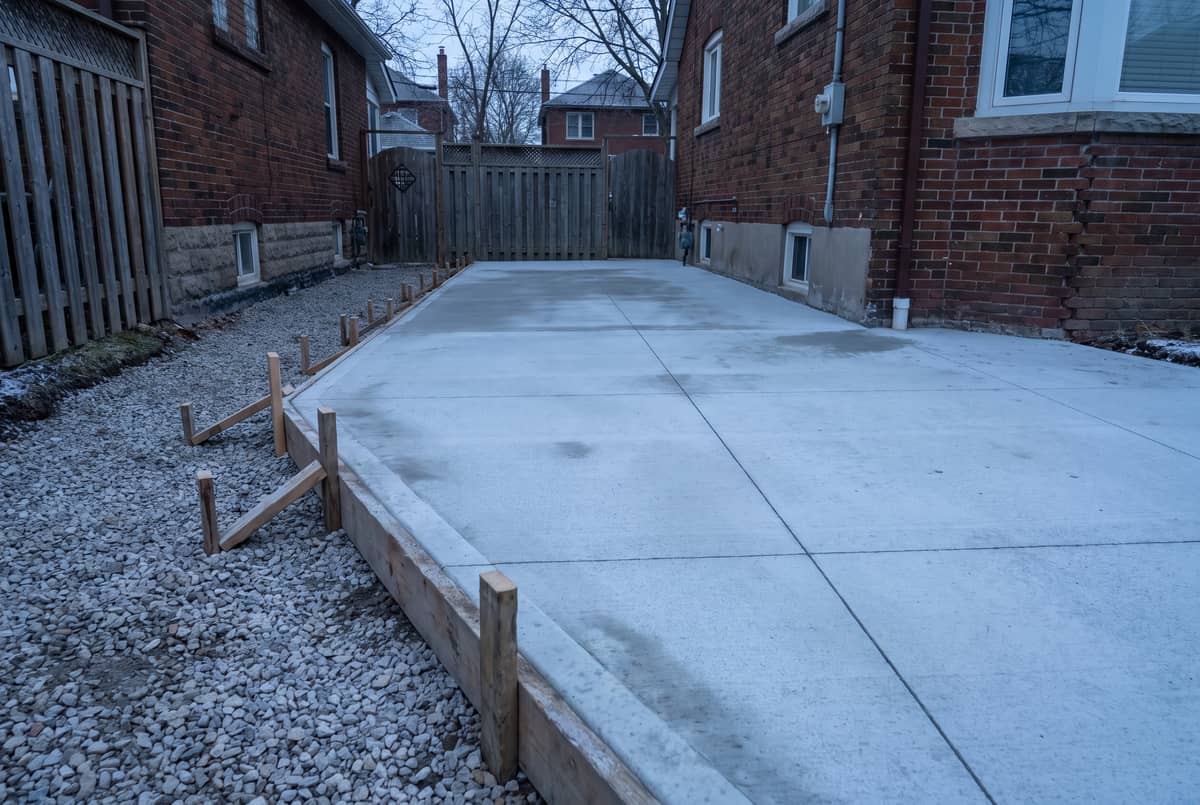
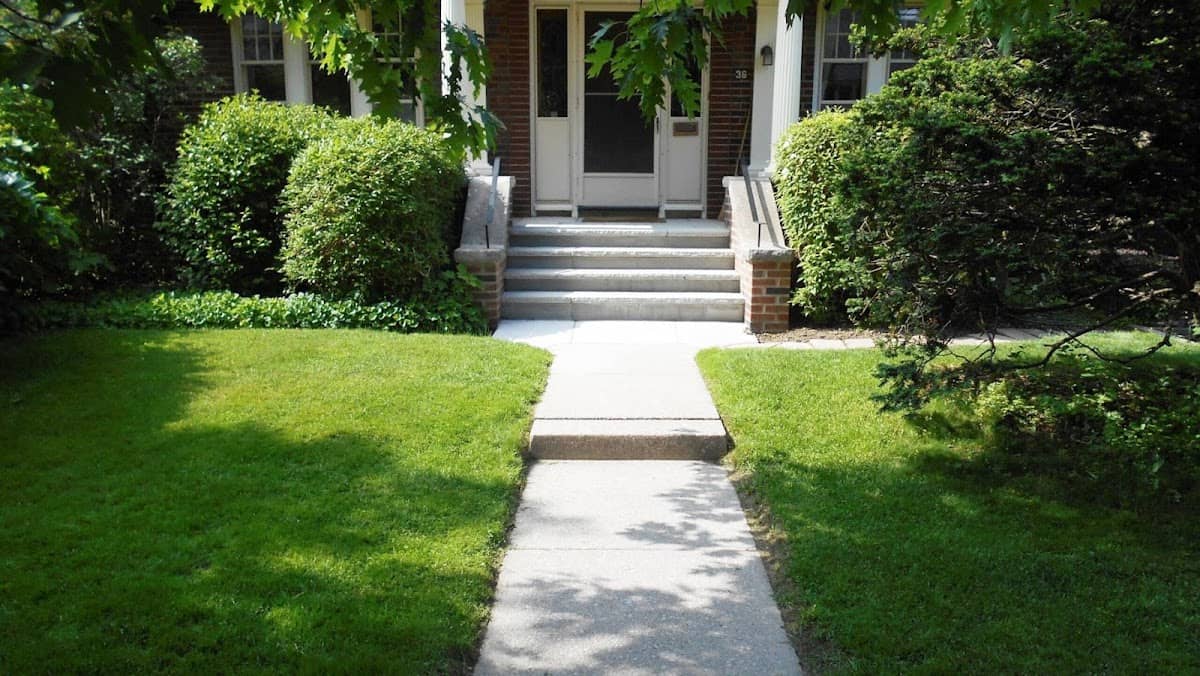
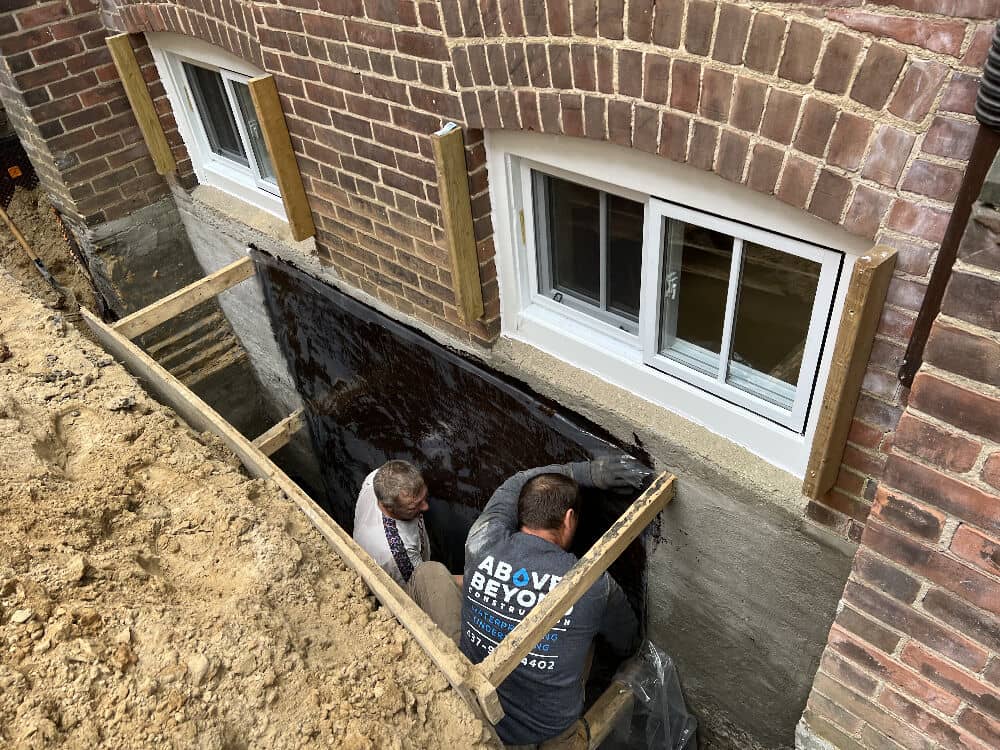
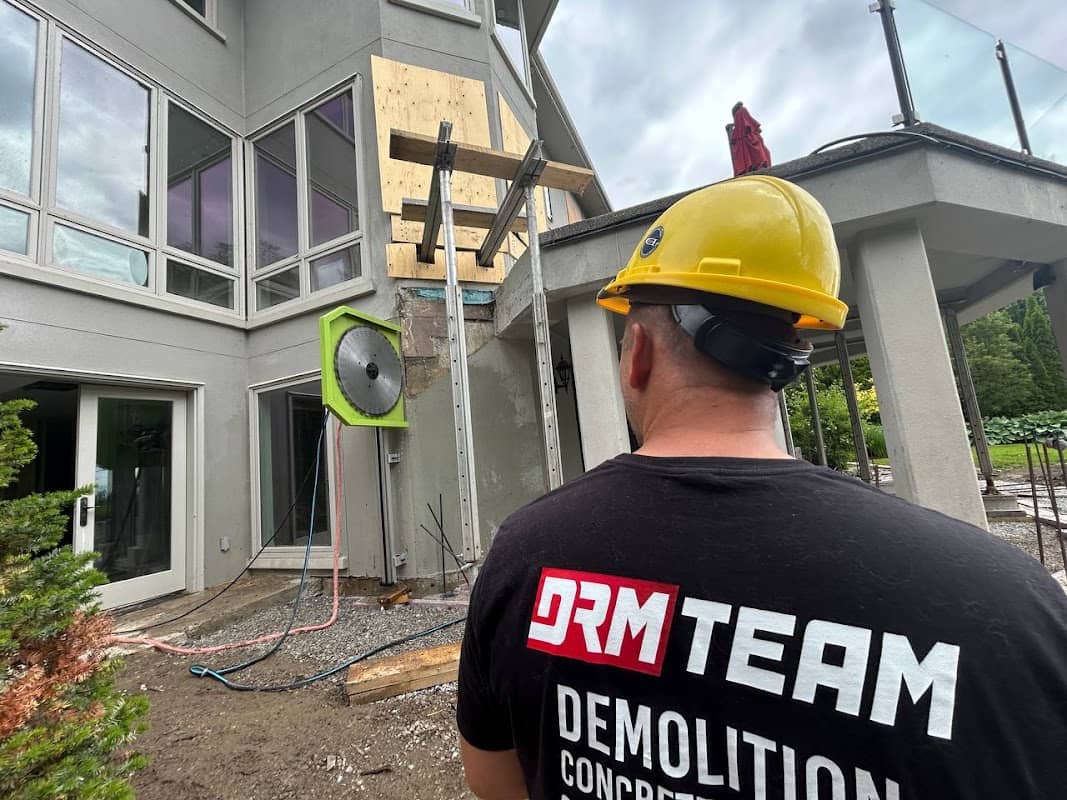
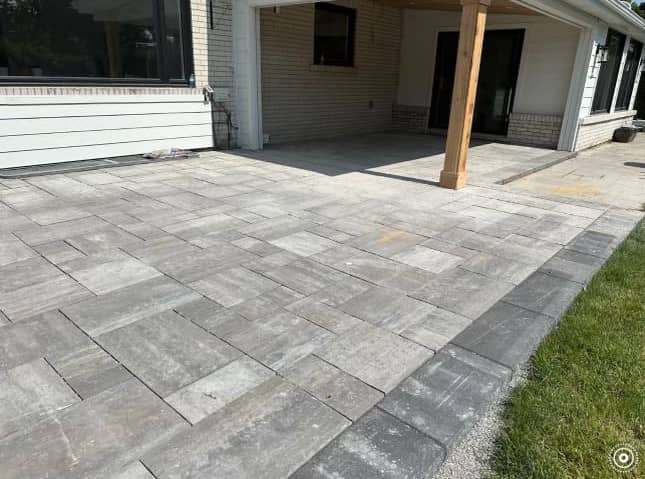
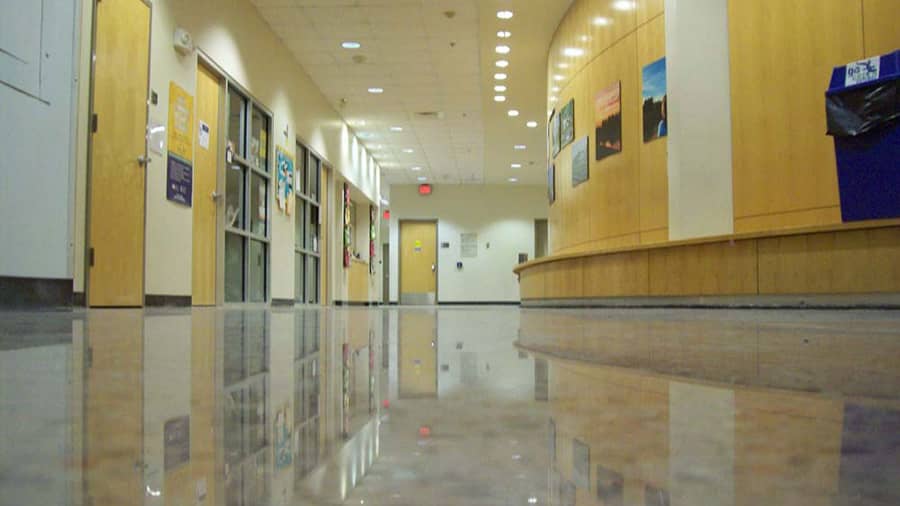
A rate per square foot is hard to picture. These are photographs published by ConcreteFinder companies working in this category across the Greater Toronto Area, at the size they deserve rather than as thumbnails. Each one links to that company's record, with its rating, its service area and its phone number.
Each photograph was published by the company shown, not chosen to sell a finish. Photographs that state a credential, a rating or an offer in the picture are excluded from this site.
What drives the price?
Spec, access and job size move concrete work pricing more than anything else in Toronto. Each factor below is tied to a figure in the table above, so you can read a quote and see where the money goes.
Mix strength (MPa): each step from 25 to 35 MPa adds $10–$25/m³ on the CBM GTA list; 40 MPa+ jumps to $301–$349/m³. Exterior work needs air-entrained 30–32 MPa, which costs more than basement-floor mixes
Order volume vs the ~3 m³ plant minimum - partial-truck charges of $175–$400 per load make tiny pours disproportionately expensive per cubic metre
Site access: if the truck can't chute directly into the forms (backyards, laneway garages, over the house), add a line pump ($500–$1,200/day) or boom pump ($1,200–$2,500/half-day)
Season: Nov 1 to Apr 30 winter handling adds $22/m3 at Canada Building Materials, and $30/m3 on lightweight mixes, plus hoarding, heating and curing-blanket costs on site
Labour intensity: budget 4–6 crew-hours per m³ for forming/pouring/finishing; complex forms, steps and stamped or exposed-aggregate finishes push labour up sharply
Reinforcement spec: mesh-only vs 10M/15M rebar grid changes material cost by several hundred dollars on a typical driveway or garage slab
Demolition and disposal of existing concrete: 2AZ Group budgets $800-$1,500 for demo and removal of an existing surface, plus bin rental of $350-$1,000 depending on size
Distance from the batch plant: standard delivery is typically included within ~30 km; beyond that expect $8–$15/km (2AZ)
Truck turnaround: 60 minutes unloading is included per CBM; slow crews pay $120/hour waiting time
Permits and securities for any work touching Toronto's right-of-way (boulevard, curb, sidewalk)
What's specific to Ontario and Toronto?
Yes, Ontario changes the math: 13% HST sits on top of every quote, City permits apply to anything touching the right-of-way, and the freeze-thaw season closes the practical pour window. Each point below is what applies locally.
HST: 13% applies on top of both material and contractor prices - Canada Building Materials' GTA list prices are all pre-HST, so a quoted $245/m³ mix is actually ~$277 landed. Get quotes stated as 'plus HST' or 'HST included' in writing
Toronto right-of-way rules: constructing, widening or altering a driveway that touches the boulevard, sidewalk or curb requires a street work permit from the District Right-of-Way Management office, plus refundable financial securities to guarantee the work matches approved plans. You cannot legally pour concrete over the City boulevard without this permit
Front-yard parking pads are a licensed use of City property and heavily restricted - many Toronto streets are under moratorium and issue no new licences. Zoning also caps driveway width and requires 50–75% of the front yard/boulevard to remain soft landscaping depending on lot frontage
Underpinning/basement lowering requires a City of Toronto building permit with structural drawings stamped by a professional engineer (P.Eng); this is never a handshake job and engineering fees come on top of the concrete work
Winter pours (Nov 1 to Apr 30) carry a $22/m3 winter handling charge on the Canada Building Materials GTA list, and $30/m3 on lightweight mixes, because plants heat water and aggregate. CSA A23.1 cold-weather protection (hoarding, blankets, accelerators) adds site cost, and many GTA flatwork contractors simply stop pouring exterior concrete from December to April.
Downtown logistics: Canada Building Materials applies a $350 restricted-load charge per load whenever Highway Traffic Act load restrictions are in effect, and parking a mixer or pump on a Toronto street can require a temporary street occupation permit.
Supplier terms are standardised across GTA plants: the 60-minute included discharge window, the per-load partial-truck charges and the winter handling window all appear on Canada Building Materials' published list and are typical of the province's ready-mix producers.
How can I pay less?
The biggest savings come from job timing, bundling small pours into one mobilization, and doing demolition yourself. Each lever below is tied to a real number in the table above, not to cutting the parts that matter.
Pour between May and October: you avoid the $22/m³ winter handling surcharge and the extra hoarding/curing-protection costs, and crews work faster in good weather
Size your job to a full or near-full truck: a 1 m³ pour carries a $400 partial-load charge at CBM. Combine your pad with a neighbour's walkway or batch several small jobs into one delivery to get closer to the ~$175 (or zero) small-load band
Do demolition and base prep yourself: breaking out and disposing of old concrete (2AZ Group budgets $800-$1,500) and excavating and compacting the granular base are the most DIY-able line items; pay the pro crew only for forming, pouring and finishing at $35-$55/hr
Plan truck access before quoting: if the mixer can chute directly into the forms you skip a $500–$2,500 pump line item entirely - sometimes removing a fence panel is worth thousands
Buy reinforcement direct: 10M bars at $8-$12 and 15M at $12-$18 per 20-foot length, and 6x6 mesh sheets at $25-$40, cost less at an Ontario supply yard than as contractor-marked-up materials on a small job (2AZ Group)
Get at least 3 itemized quotes showing concrete volume, MPa, reinforcement and finishing separately - published GTA totals for the same 20x20 garage slab span $5,000 to $8,000 on one contractor's own list
Order accurate volume with a 5–10% buffer only: over-ordering 1 m³ wastes ~$250+, while under-ordering triggers a second delivery with its own small-load fee
How did we research these numbers?
Every price on this page was re-opened at its source and matched to the sentence that carries it. Where sources disagree, ConcreteFinder keeps each row on one publisher's own figure and writes the disagreement down here rather than blending them into a range nobody published.
Sources disagree on delivered ready-mix pricing rather than agreeing on one range. Builders Ontario's 2026 calculator cites $175-$225/m3 delivered for 25-32 MPa; Canada Building Materials' own GTA producer list (in effect January 15, 2026) is $245/m3 for 25 MPa and $255/m3 for 30 MPa before a $7/m3 environmental charge, a $2/m3 fuel surcharge and a $1/m3 industrial emissions charge; 2AZ Group's GTA guide cites $250-$290/m3 as-delivered for 25 MPa. Each row here carries one publisher's own figure. Expect real 416/905 quotes near the top of that spread.
All figures are CAD and exclude 13% HST unless stated. The one US source that surfaced (HomeGuide rebar guide) was excluded rather than converted; every price row above is from a Canadian source.
Small pours are penalized twice: most GTA plants run a ~3 m³ practical minimum, and CBM's per-load partial-truck charges scale from $175 (3.2–4 m³) to $400 for a single cubic metre. 2AZ frames the same reality as a $50–$80/m³ short-load surcharge below 3 m³.
Most GTA pumping outfits publish no rates and quote per job on boom size, hose length and access. The only published figures used here are Rockit's $500-$1,200 per day for a line pump and 2AZ Group's half-day boom rates of $1,200-$1,800 for a 28 to 36 metre boom and $1,800-$2,500 for 42 metres and up.
Job Bank's $28.80–$47.00/hr is what Toronto-region concrete finishers are paid as employees; contractor charge-out rates run higher ($35–$55/hr per 2AZ), and a common rule of thumb is 4–6 labour-hours per cubic metre poured for forming, placing, finishing and stripping.
Installed per-square-foot pricing varies widely with demolition, base prep and finish. This guide no longer carries a per-square-foot Toronto flatwork row: its only source was a HomeStars price guide that returns HTTP 403 to every non-browser request, so the figure could not be checked and was removed. The installed figure that remains is 2AZ Group's subcontractor total for a standard 20x20 garage slab, $5,000-$8,000.
Welded wire mesh is $25-$40 per 4x8 sheet at GTA supply yards (2AZ Group). A retailer listing that showed a lower figure now blocks non-browser requests, so it was dropped rather than repeated unverified.
ConcreteFinder tracks 540 concrete contractors across the Greater Toronto Area, rated 4.75★ on average. The three below rank highest on our review-weighted score, based on ConcreteFinder's analysis of 540 GTA businesses, July 2026.
Where in the Greater Toronto Area can you get this done?
One thing the address genuinely changes is access, which every quote on this page is sensitive to: a downtown lot a truck cannot chute into means a pump or a wheelbarrow crew, and a rear-laneway job is formed differently from an open suburban frontage. The other is how many companies will bid at all. These are the Greater Toronto Area areas where ConcreteFinder tracks the most concrete contractors, with the count on each.
A quote is hard to compare when half of it is trade vocabulary. These are the terms used in the table above, defined in the words a contractor would use.
Short-load charge
A per-load fee a ready-mix plant adds when you order less than a full truck. Canada Building Materials charges $175 for a 3.2 to 4 cubic metre load and $400 for a single cubic metre, which is why a small pour costs far more per cubic metre than a large one.
Boom pump
A truck-mounted articulated arm that places concrete where a mixer chute cannot reach, such as a backyard or a laneway garage. Booked separately from the concrete order and priced by boom length.
MPa
Megapascals, the compressive strength of a concrete mix. Ontario residential flatwork is normally 25 to 32 MPa; higher numbers cost more per cubic metre because they carry more cement.
Air-entrained concrete
A mix with microscopic air bubbles deliberately introduced so water has somewhere to expand when it freezes. It is the standard specification for exterior concrete in Toronto's freeze-thaw climate.
Granular base
The compacted crushed stone layer poured concrete sits on, usually Granular A. Depth and compaction of this layer, not the slab, are what stop a driveway or patio settling.
Which other costs should I check?
Most concrete work quotes arrive alongside another one. These are the three ConcreteFinder guides closest to this job, each priced from its own named sources.
How much does ready-mix concrete cost per cubic metre in Toronto?
Canada Building Materials' January 2026 GTA list price is $245/m³ for 25 MPa and $255/m³ for 30 MPa, plus a $7 environmental charge and $2 fuel surcharge, before 13% HST. Market guides quote $175–$290 delivered depending on supplier and volume. Budget roughly $250–$280/m³ all-in for a typical residential exterior mix.
Why does a small concrete pour cost so much per cubic metre?
GTA plants run a practical 3 m³ minimum, and partial-truck charges punish small orders: CBM charges $175 per load for 3.2–4 m³, $300 for 1.2–3 m³, and $400 to deliver a single cubic metre. A 1.5 m³ backyard pad can cost roughly double its raw material value once the small-load fee lands.
How much does concrete pumping cost in Toronto?
Line pumps for residential pours run $500–$1,200 per day per Rockit Concrete Pumping. Boom pump trucks with operator run $1,200–$1,800 per half-day for a 28–36 m boom and $1,800–$2,500 for 42 m+ per 2AZ Group. You need a pump whenever the mixer truck can't chute directly into your forms - typically backyards and laneway garages.
What do concrete workers charge per hour in Toronto?
Job Bank puts Toronto-region concrete finisher wages at $28.80 to $47.00 an hour, with a median of $43.58, over the 2023-2024 reference period. That is what finishers are paid, not what a contractor charges: 2AZ Group's GTA charge-out is $35 to $55 an hour for a formwork carpenter and $45 to $65 for a foreman. Budget 4 to 6 labour-hours per cubic metre poured, so a 3 m3 garage slab is roughly $1,200 to $1,800 in labour.
Can I pour concrete in winter in Toronto?
Yes, but it costs more. Canada Building Materials adds a $22 per cubic metre winter handling charge from November 1 to April 30, and $30 on lightweight mixes, because plants heat the water and aggregate. Add site protection (hoarding, curing blankets, accelerators), and note many flatwork contractors simply stop exterior pours from December through April.
Do I need a permit to pour a concrete driveway or parking pad in Toronto?
Repaving your existing driveway footprint on private property generally needs no permit, but widening it, cutting the curb, or pouring on the boulevard requires a street work permit from Toronto's Right-of-Way Management office plus refundable financial securities. Front-yard parking pads are licensed and many streets ban new ones; zoning requires 50–75% of the front yard to stay soft landscaping.
How much does rebar or wire mesh add to a concrete slab?
In the GTA, 2AZ Group prices 10M rebar at $8 to $12 per 20-foot bar, 15M at $12 to $18 and 20M at $18 to $28, and 6x6 welded wire mesh at $25 to $40 per 4 by 8 sheet. On a typical 400 sq ft driveway, reinforcement adds a few hundred dollars in materials, which is cheap insurance against cracking.
What does a concrete garage slab cost installed in the GTA?
2AZ Group prices a standard 20 by 20 foot garage slab at $5,000 to $8,000 installed by a subcontractor in the GTA, materials and labour included. A standard residential basement floor is $6,000 to $10,000 on the same list. Removing an old slab first is a separate line: 2AZ budgets $800 to $1,500 for demo and removal.
Questions to ask your contractor
1
Can you show WSIB clearance and liability insurance for this job?
2
Will you pull the permits this scope needs, or is that on me?
3
What concrete strength and slab thickness are you pouring for this use?
4
How will you reinforce it: rebar, wire mesh, or fibre, and where do the control joints go?

 1
1