Why Concrete Cracks in Toronto, and Which Cracks Actually Matter
By ConcreteFinder Research TeamPublished 7 min read
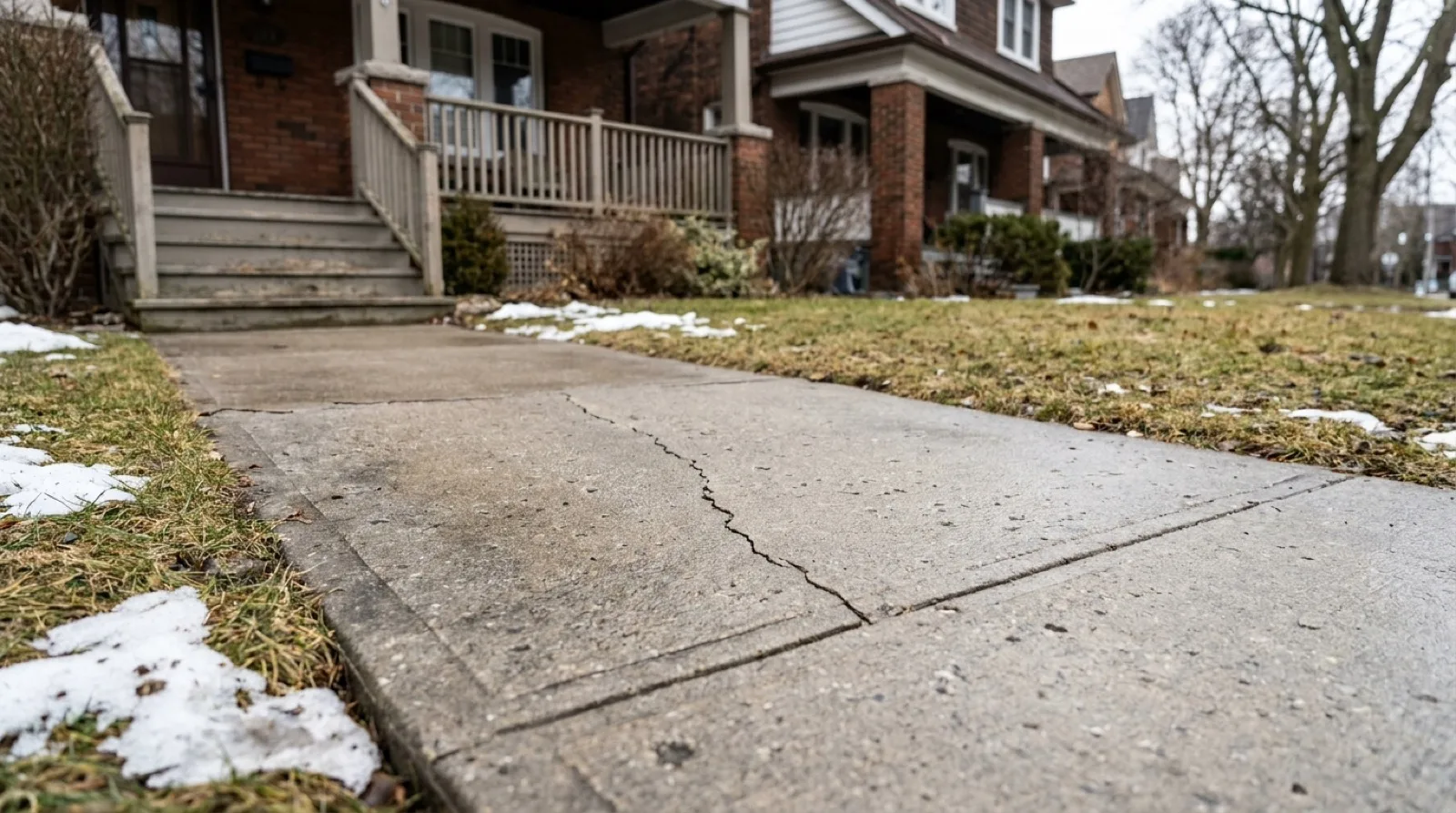
Concrete cracks. Not because it was poured badly, though it can be, but because it is a rigid material that shrinks as it cures, sits on ground that moves, and spends four months a year in a city that freezes and thaws it repeatedly. A slab that has never cracked is usually a young slab.
That makes the useful question narrower than "is it cracked". It is whether this particular crack is the ordinary kind that a sealer handles, or a symptom of something moving underneath. This guide is about telling those apart, and about what the GTA climate does to concrete that milder climates do not.
What freeze-thaw actually does to a slab
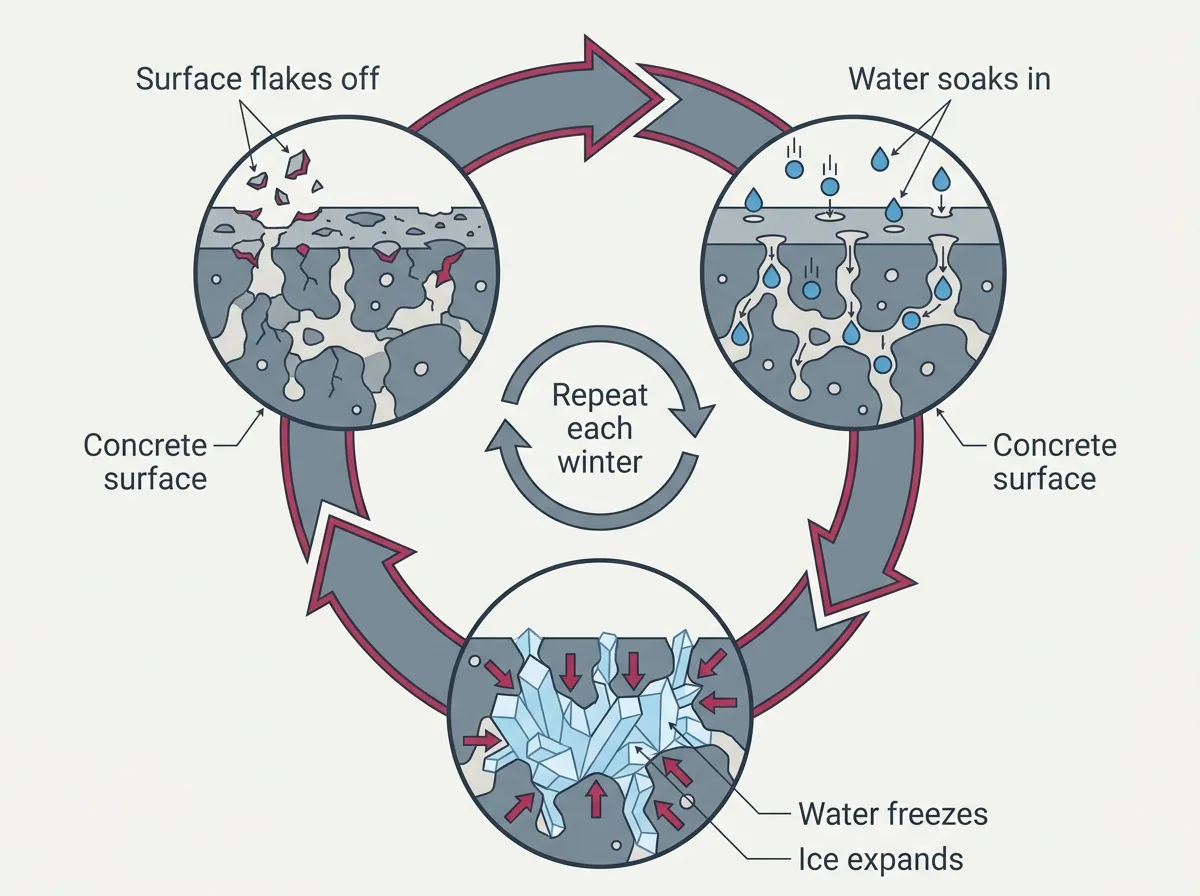
Freeze-thaw is not one event, it is a cycle that repeats through a Toronto winter. Water works into the pore structure at the surface of the concrete, freezes, expands, and pushes outward against the concrete around it. When it thaws, the slightly widened pore takes on more water than before, and the next freeze pushes harder. Over enough cycles the surface flakes away, which is the damage contractors call spalling.
This is the root cause of most spalling and most parging failure in the GTA, and it is why a repair that ignores it does not last. Alasya Construction reports that single-coat consumer-grade parging typically fails within two to three winters, which is a useful benchmark for how quickly this climate finds a weak surface.
De-icing salt makes it worse. Salt accelerates surface spalling on GTA driveways and steps, and contractors commonly recommend a penetrating sealer after any resurfacing for that reason. Nusite Group describes resurfacing products that include penetrating sealers creating a protective barrier against salt infiltration, and Green Building Canada prices professional sealing at $1 to $2 per square foot.
Three kinds of crack, three different conversations
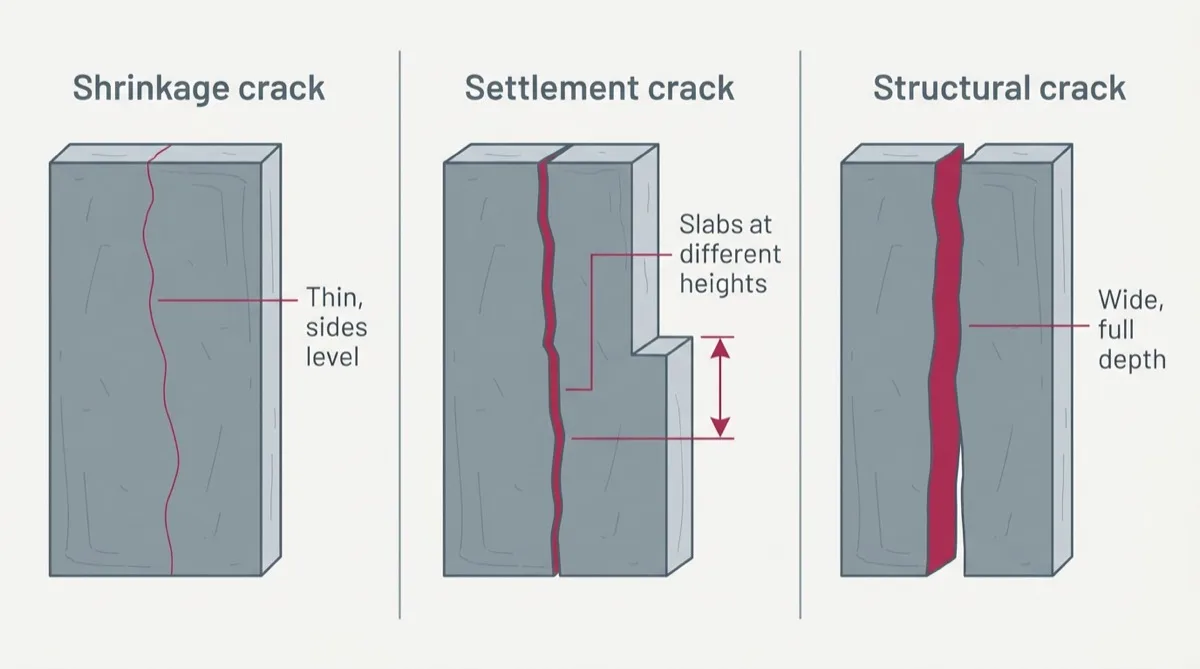
The distinction that matters is not how long a crack is, it is how wide it is, whether the two sides are still at the same height, and whether it is doing anything.
A fine shrinkage crack is the most common thing you will see. It is thin, it wanders, and the concrete on both sides is level. It appears as the slab cures and gives up water, and on a driveway or patio it is a maintenance item rather than a problem: it wants sealing so that water and salt stop getting in.
A settlement crack is the one where the slab on one side has dropped. The tell is a step you can feel with a foot or catch with a shoe. That is the ground moving, not the concrete failing, and sealing it fixes nothing because the void underneath is still there.
A structural crack is wide, runs through the full depth, and on a foundation wall it may be actively leaking. That is the category where the right next call is a contractor rather than a hardware store, and where the repair method depends on what the crack is doing. On poured foundations, DryShield's own tiers separate polyurethane injection, best for stopping active leaks with a flexible seal, from epoxy injection, used for bonding structural cracks where strength has to be restored.
What a control joint is really for
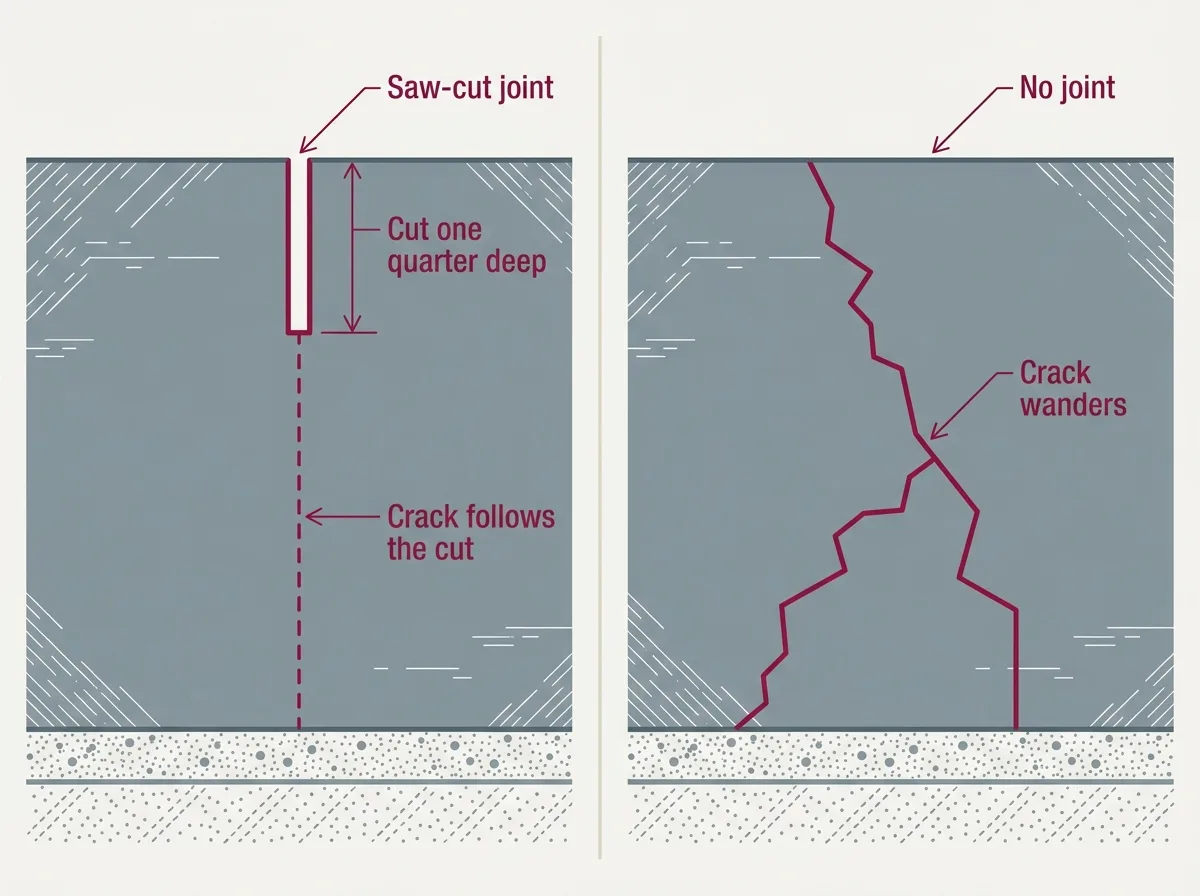
The straight grooves cut into a driveway or patio are control joints, and their job is routinely misunderstood. They do not stop a slab cracking. They create a deliberately weakened plane so that when the slab does crack, it cracks straight down the line of the groove, where nobody notices it.
That is why a slab with no joints, or with joints cut too shallow or too far apart, tends to crack in a wandering diagonal instead. The crack was going to happen either way; the joint pattern only decided whether it would look like a design feature or like damage.
It is worth asking a contractor where the joints will go before the pour, in the same conversation as slab thickness and reinforcement. It is one of the few decisions that is free to get right and impossible to change afterwards.
When a crack is worth paying someone to look at
The honest answer is that most cosmetic cracks are worth batching rather than chasing one at a time. Most GTA concrete contractors carry an effective minimum call-out of roughly $500 to $900, so a single hairline crack or one step edge rarely prices below that regardless of the per-unit rate, and bundling several cracks or slabs into one visit reduces the cost of each.
For scale on the small end, Toronto Concrete Repairs prices minor surface crack sealing on a porch, walkway or slab at $600 to $900 for a day of work, and moderate spalling repair on steps or a porch surface at $1,000 to $1,500 for one to two days. Both are in the same territory as the minimum call-out, which is exactly the point.
The cracks that should not wait are the ones on a foundation wall that leak, and the ones with a vertical step that is growing. Those are movement, and movement gets more expensive the longer it runs. Our guide on repairing, resurfacing or replacing concrete walks through which route each of those leads to, and the concrete repair cost guide carries the full sourced price table.
What you can actually do about it
Almost all of the useful prevention happens at two moments: when the slab is poured, and every autumn afterwards.
At the pour, the decisions are mix, thickness, reinforcement and joint layout, and they are the contractor's to specify and yours to have in writing. After that, the work is keeping water and salt out of the surface, which means sealing early rather than after the surface has already opened up.
ConcreteFinder lists 93 GTA companies under concrete repair and levelling. That is a deep enough field that it is worth getting more than one opinion on what a crack means before agreeing to a method, particularly on anything described as structural.
- Seal before the surface opens up, not after. Green Building Canada prices professional sealing at $1 to $2 per square foot.
- Keep de-icing salt off new concrete, since salt accelerates surface spalling on GTA driveways and steps.
- Batch small repairs into one visit, because the roughly $500 to $900 minimum call-out dominates single-item pricing.
- Treat a vertical step between slabs as ground movement, not a surface defect.
- Get the joint layout, slab thickness and reinforcement written into any quote for a new pour.
Frequently asked questions
Is a hairline crack in my driveway a problem?
Usually not on its own. A fine crack with both sides at the same height is typically shrinkage, which is what concrete does as it cures. It is worth sealing so water and de-icing salt stop getting into it, because that is what turns a cosmetic line into surface spalling over a few Toronto winters.
Why is my concrete surface flaking off?
That is spalling, and in the GTA the usual cause is freeze-thaw made worse by de-icing salt. Water gets into the surface, freezes, expands and breaks small flakes away, and each cycle opens the surface a little more. A penetrating sealer is the standard preventive measure; Green Building Canada prices professional application at $1 to $2 per square foot.
Do control joints stop concrete from cracking?
No. A control joint creates a weakened plane so the crack that was going to happen anyway follows a straight line instead of wandering across the slab. A slab with no joints, or joints cut too shallow, still cracks; it just cracks somewhere you did not choose.
How do I know if a crack is structural?
Width, depth and movement are the signals. A wide crack running the full depth of a slab or foundation wall, a crack that leaks, or one where the two sides sit at different heights and the difference is growing, all point at something beyond surface repair. A fine crack with level sides and no water is a different category.
How much does it cost to fix one small crack in Toronto?
More than the crack is worth on its own, which is the practical answer. Most GTA contractors carry an effective minimum call-out of roughly $500 to $900, and Toronto Concrete Repairs prices minor surface crack sealing at $600 to $900 for a day of work. Bundling several repairs into one visit is what brings the per-item cost down.
Related reading
How ConcreteFinder is paid, and who wrote this
This guide was researched and written by the ConcreteFinder Research Team, published on August 20, 2026. Every figure above was re-opened at the page it came from on the day this went live, and each one names that source in the sentence that uses it. Every Greater Toronto Area concrete business on this site is listed free, and no company can pay for a position in the rankings or for a mention in an article. What ConcreteFinder does and does not charge for is set out on our page for contractors, and money is kept apart from the rankings on purpose. The ranking formula is published in full on our methodology page, and if a figure here is wrong we would rather hear about it, through contact.
Compare Greater Toronto Area concrete companies
No obligation. We match you with exclusive, local pros, so you compare and choose.