What Road Salt Does to Toronto Concrete, and What It Costs to Fix
By ConcreteFinder Research TeamPublished 9 min read
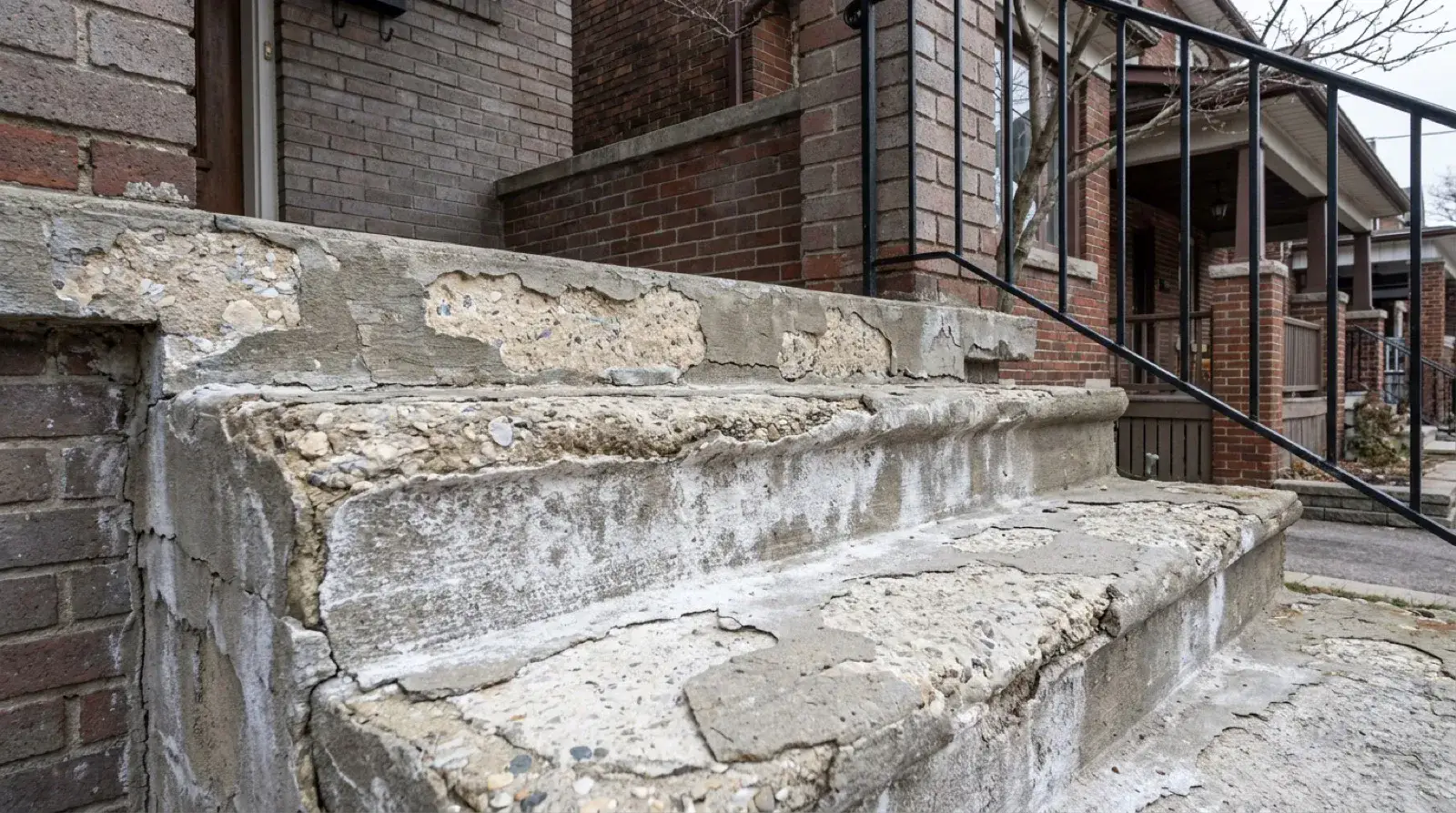
Every winter a share of the salt on Toronto roads ends up on private concrete: tracked up a driveway by tires, shovelled onto steps, spread across a garage apron. Homeowners tend to picture it as a chemical attack, with the salt dissolving the concrete. What the sources describe is slower and more mechanical, and the distinction matters because it changes what actually prevents the damage.
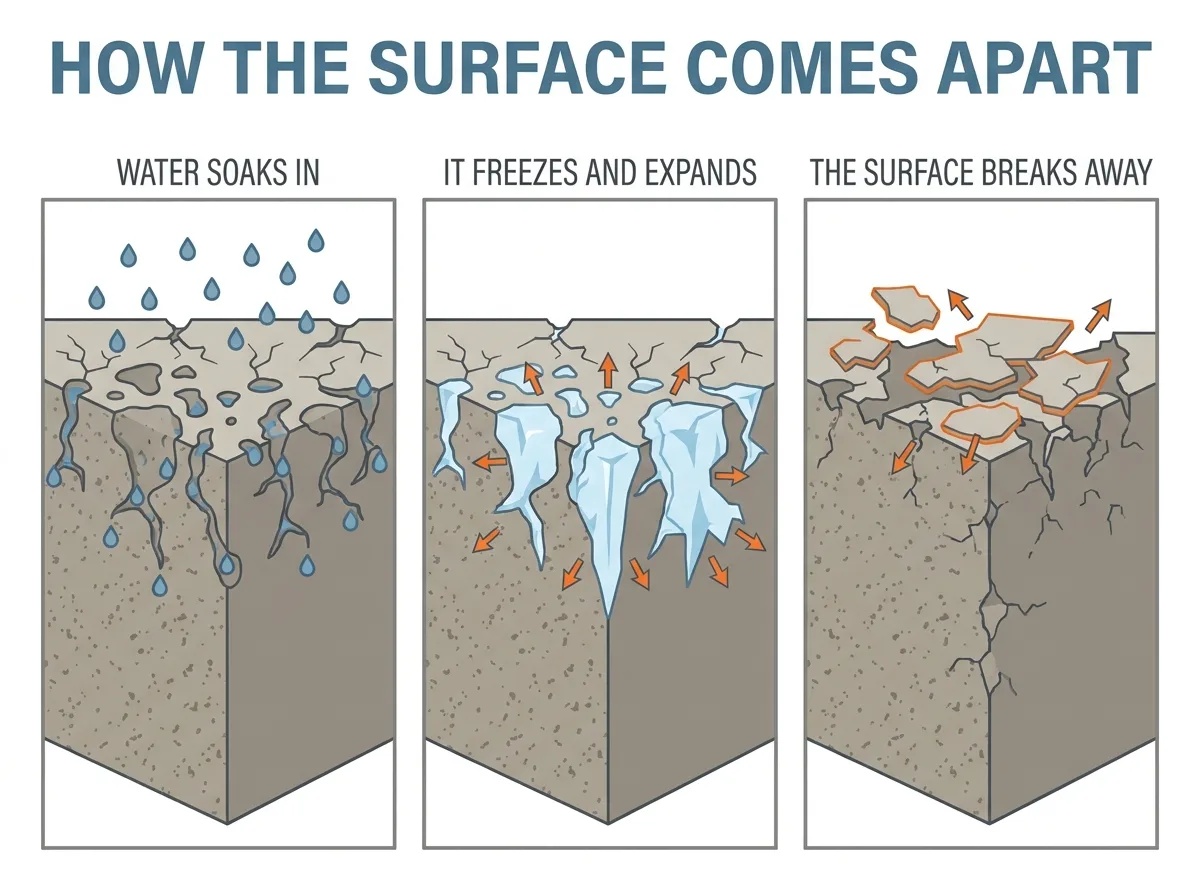
Concrete is porous, and the damage starts with water getting into those pores. Nusite Group describes what each cycle does: water penetrating the concrete expands when frozen, creating pressure that causes scaling, spalling and cracking. It calls that cycle the primary culprit behind accelerated concrete deterioration in the region.
How many cycles a Toronto winter actually delivers depends on who you ask, and the two sources here do not agree. Nusite Group puts it at 40 to 60 a year. Toronto Concrete Repairs says winter temperatures fluctuate around freezing 20 to 40 times per season, and adds that water expands 9 percent when it freezes. Either figure is dozens of cycles a year, which is the point.
Salt is the accelerant on top of that. Nusite states that sodium chloride and other de-icing chemicals accelerate concrete deterioration.
What salt actually does to a concrete surface
The flaking itself has a name. Spalling is when the top layer of a slab breaks away and the surface loses its skin; scaling is the milder version of the same thing. Both begin at the top and work down, which is why a slab can look finished long before it structurally is.
Dozens of cycles a year is the part worth sitting with. That is not one hard winter event. It is a surface being loaded and unloaded dozens of times between November and March, every year, for the life of the slab. Writing about porches, Toronto Concrete Repairs names three things acting on the concrete: salt damage from de-icing products, moisture intrusion that freezes and causes surface failure, and the freeze-thaw cycles themselves. All three work on the same few millimetres.
The useful consequence is that this is a surface problem rather than a structural one in its early stages. A slab can be perfectly sound at depth while the top few millimetres have given up entirely. That distinction is what decides the repair, and it is the question to put to a contractor first.
Where it shows up first, and why those places
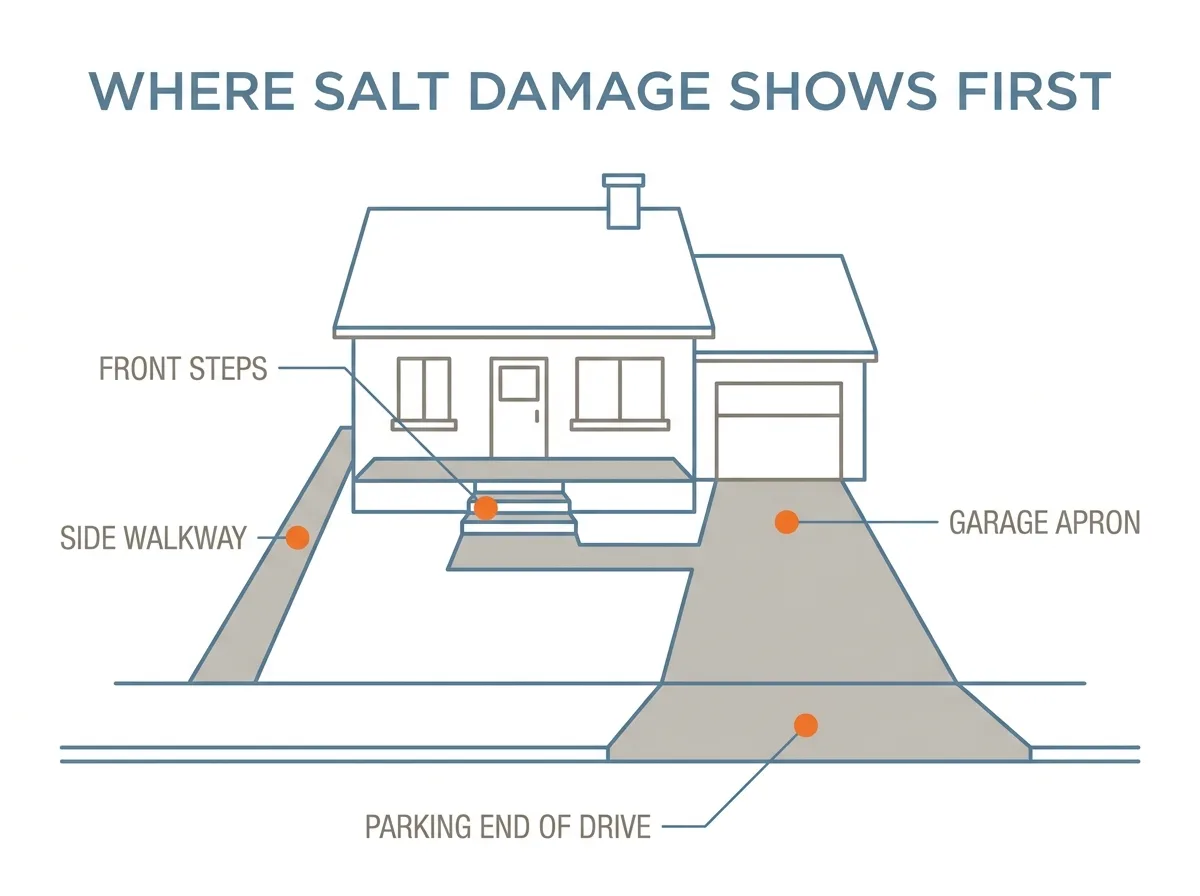
Salt damage is not evenly spread across a property, and knowing where to look tells you how far along it is. What follows is ConcreteFinder's own reading of where it turns up, reasoned from how salt reaches each surface, rather than a figure off a published page.
Front steps and porches usually go first, because they are salted directly and by hand, often generously. The garage apron, the strip between the garage door and the driveway, comes next, along with the first couple of metres of driveway: that is where salt-laden slush drops off a car as it parks. Walkways to a side or back door follow the same pattern as the steps. The middle of a large driveway, which gets salt only off tires, usually lasts longest.
The early sign is not a crack, it is texture. Toronto Concrete Repairs lists four signs of spalling without ranking them: a flaking or peeling surface, pockmarks or pitting, exposed aggregate, and a rough uneven texture. Putting them in the order a homeowner tends to meet them is ConcreteFinder's own reading, not theirs, and it runs roughness and pitting first, then visible flaking, then bare aggregate. By the time flakes are lifting, the surface layer has already lost cohesion. By the time aggregate is showing across an area, sealing is no longer the answer.
What each stage of repair costs in the GTA
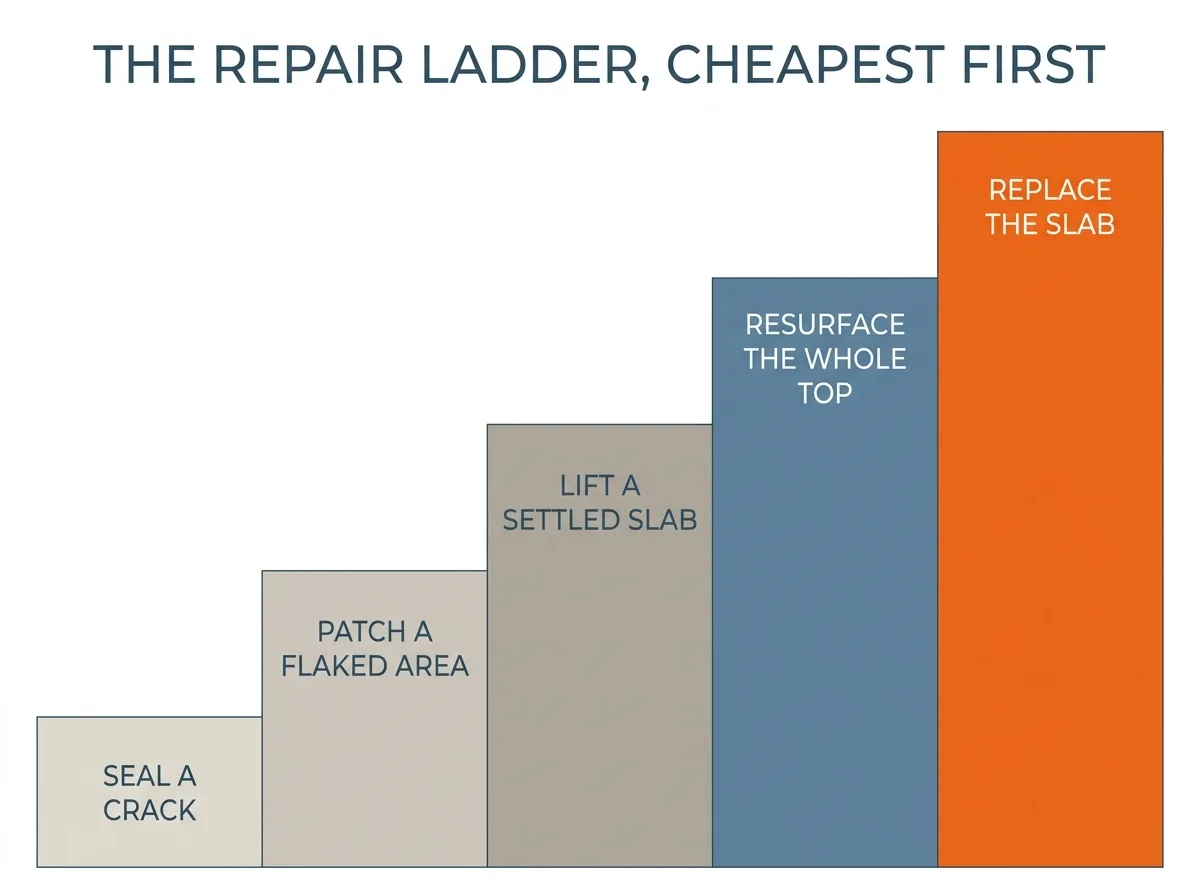
The useful thing about salt damage is that it progresses through recognisable stages, and each stage has a different and published price. Toronto Concrete Repairs publishes a table of average costs by project type for Toronto and the GTA.
Minor crack sealing on a porch, walkway or slab runs $600 to $900 for a day of work. Moderate spall repair on steps or a porch surface is $1,000 to $1,500 for one to two days. Mudjacking or levelling a settled walkway or porch slab is $1,200 to $2,500 for a day, mudjacking being the pumping of a grout under a sunken slab to lift it back to level. Full surface resurfacing is $2,500 to $4,500 over two to three days.
Above that sits replacement, and the comparison is where the money is. Nusite Group prices a resurfacing overlay at $4 to $8 per square foot for materials and labour, against $12 to $18 per square foot for complete replacement. On those two ranges an overlay lands somewhere between a fifth and two thirds of the cost of replacing the slab, depending which end of each you fall on. That only holds when the slab underneath is structurally sound. When it is not, an overlay is money spent on a surface that will move with whatever is moving beneath it.
Our resurfacing or replacing calculator walks through which of those two a given slab is a candidate for, and the concrete repair cost guide carries the full sourced table.
Sealing: the cheap move, and how often the sources say to do it
A penetrating sealer is the standard preventive measure, and its job is to keep water and dissolved salt out of the pore structure in the first place. Nusite Group describes modern resurfacing products that include penetrating sealers creating a protective barrier against salt infiltration.
Green Building Canada prices professional sealing at $1 to $2 per square foot and DIY sealing at $0.50 to $0.75 per square foot in materials, and calls it optional but commonly recommended in cold climates every five to ten years. Toronto Concrete Repairs' own driveway comparison table is stricter, listing maintenance for concrete as sealing every four to five years.
There is a third figure, on the porch repair page quoted earlier for the repair prices: writing about a sealed porch repair, Toronto Concrete Repairs recommends resealing every two to three years for maximum protection in Toronto's climate. So one company publishes two different intervals depending on which page you land on, and a national guide publishes a third. Green Building Canada scopes its five-to-ten-year figure to cold climates too, so the gap is not a warm-climate artefact. If you are salting a surface every winter, the shorter intervals are the safer ones to plan around.
One more piece of advice is worth separating out, because it is ConcreteFinder's own rather than a figure off a published page. Keep de-icing salt off a slab through its first winter. A surface that has not fully hardened has the least resistance it will ever have, and damage done in that first season does not heal.
- Seal before the surface roughens, not after flakes start lifting.
- Keep de-icing salt off new concrete through its first winter, which is ConcreteFinder's own guidance rather than a published figure.
- Shovel early rather than salting heavily, so less salt sits on the surface at all.
- Check the steps and the garage apron first when judging how far the damage has gone.
- Batch small repairs into one contractor visit, since a call-out minimum dominates single-item pricing.
When it is past sealing, and who to ask
Sealing an already-spalled surface does not restore it. Once the top layer has lost cohesion the choice is between an overlay, which gives the surface back, and a replacement, which gives the slab back. Which one applies is decided by what is happening underneath, not by what the top looks like.
The question to ask a contractor is therefore not "can this be sealed" but "is the slab under this sound". A slab with level sides, no settlement and surface-only damage is an overlay candidate at $4 to $8 per square foot. A slab where sections sit at different heights is moving, and an overlay over movement fails. Our guide on why concrete cracks in Toronto sets out how to tell those apart.
If the slab turns out to need replacing rather than resurfacing, our guide on why a small concrete job still costs thousands explains the price floor that then applies. ConcreteFinder indexes 83 GTA companies under concrete repair and levelling, out of 770 concrete companies overall. That is a deep enough field to get more than one opinion on which side of the line a surface sits. It is worth doing before agreeing to a method, since the two routes sit in different price brackets.
Frequently asked questions
Does road salt damage concrete?
Nusite Group states that sodium chloride and other de-icing chemicals accelerate concrete deterioration, on top of a climate that already puts Toronto through dozens of freeze-thaw cycles a year: 40 to 60 by Nusite's count, 20 to 40 per season by Toronto Concrete Repairs'. In each cycle, water penetrating the concrete expands as it freezes, creating pressure that causes scaling, spalling and cracking.
How much does it cost to fix salt damage on concrete steps in Toronto?
Toronto Concrete Repairs prices moderate spall repair on steps or a porch surface at $1,000 to $1,500 for one to two days of work, with minor crack sealing below that at $600 to $900 and full surface resurfacing above it at $2,500 to $4,500.
Should I resurface or replace a salt-damaged driveway?
It depends on the slab underneath, not on the surface. Nusite Group prices an overlay at $4 to $8 per square foot against $12 to $18 per square foot for complete replacement. On a 400 square foot single-car driveway those rates work out at $1,600 to $3,200 to overlay against $4,800 to $7,200 to replace, so the overlay is the cheaper route by a wide margin when the base slab is sound. Where sections have settled to different heights, the movement will come through any overlay.
How often should concrete be sealed in Toronto?
The sources disagree, usefully. Toronto Concrete Repairs lists concrete driveway maintenance as sealing every four to five years. Green Building Canada calls sealing optional but commonly recommended in cold climates every five to ten years, and prices professional application at $1 to $2 per square foot. A driveway that is salted every winter belongs at the shorter end.
Can I use salt on a new concrete driveway?
No, not in its first winter, and that is ConcreteFinder's own guidance rather than a figure off a published page. Fresh concrete has the least resistance to surface damage it will ever have, and damage done in that first season does not heal. Shovelling early, and keeping salt off the surface entirely where you can, is what gets a new slab through its first winter intact.
Sources
Every figure in this article is either counted from ConcreteFinder's own index of Greater Toronto Area concrete companies or copied from one of the pages below, which is named in the sentence that uses it.
- Toronto Concrete Repairs - concrete porch repair costs (average costs by project type)
- Toronto Concrete Repairs - concrete driveways Toronto (maintenance and sealing interval)
- Nusite Group - concrete driveway resurfacing for property managers (overlay against replacement per square foot)
- Green Building Canada - 2026 Canadian concrete driveway cost guide (sealing price and interval)
Related reading
How ConcreteFinder is paid, and who wrote this
This guide was researched and written by the ConcreteFinder Research Team, published on September 17, 2026. Every figure above was re-opened at the page it came from on the day this went live, and each one names that source in the sentence that uses it. Every Greater Toronto Area concrete business on this site is listed free, and no company can pay for a position in the rankings or for a mention in an article. What ConcreteFinder does and does not charge for is set out on our page for contractors, and money is kept apart from the rankings on purpose. The ranking formula is published in full on our methodology page, and if a figure here is wrong we would rather hear about it, through contact.
Compare Greater Toronto Area concrete companies
No obligation. We match you with exclusive, local pros, so you compare and choose.