Repair, Resurface or Replace: Deciding What a Toronto Driveway, Walkway or Porch Actually Needs
By ConcreteFinder Research TeamPublished 7 min read
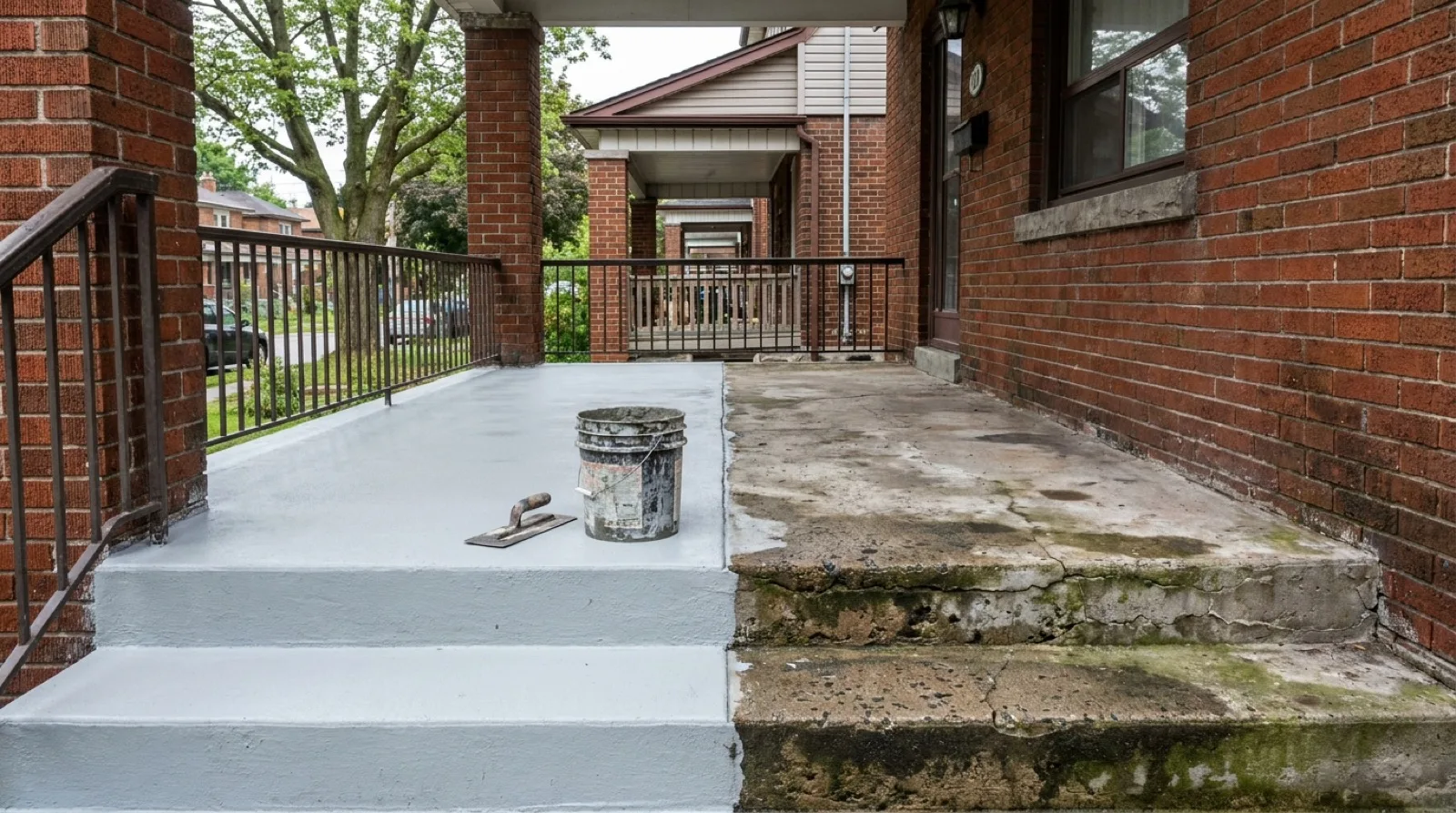
Most homeowners come to this decision from the surface: the driveway looks tired, the porch is pitted, a walkway slab has dropped. The surface is the least useful place to judge from, because four very different jobs can all look the same from standing height, and they are separated by roughly an order of magnitude in cost.
The question that actually sorts them is whether the concrete underneath is still structurally sound. Everything cosmetic is a choice once the answer is yes. If the answer is no, the choice is gone. This guide works through that decision and puts a sourced GTA number against each route.
The one question that sorts everything else
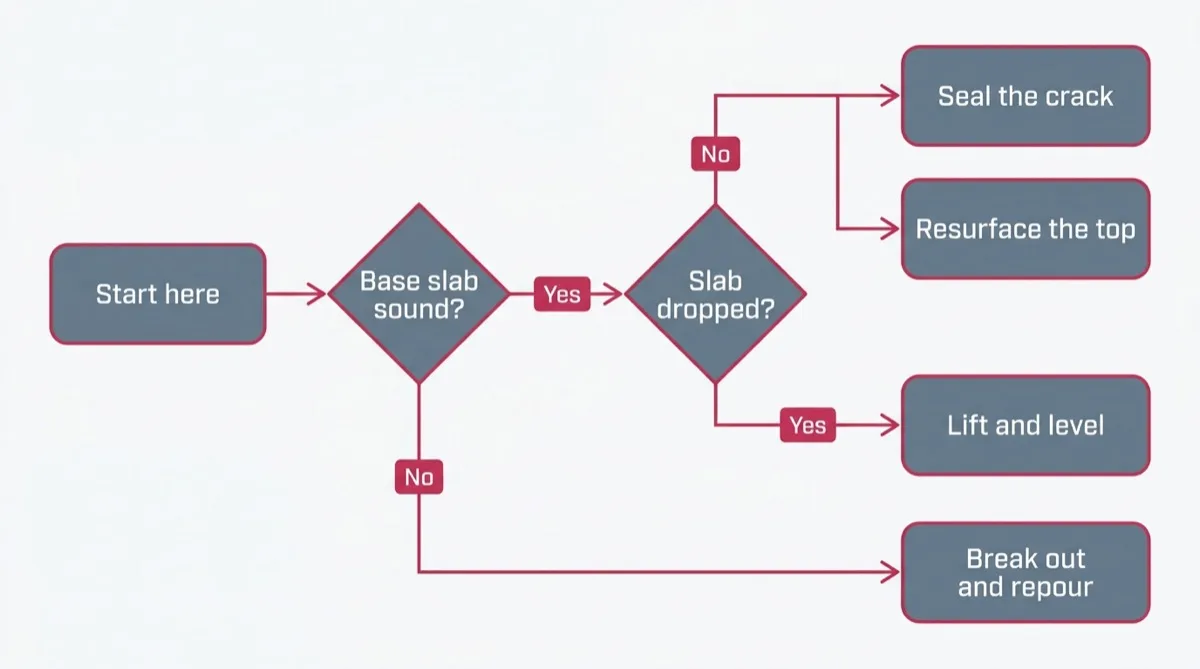
Start with the base slab, not the finish. An overlay bonds a thin new wearing layer onto the existing concrete, so it inherits whatever the existing concrete is doing. Overlays only work over sound concrete, which is why a contractor who agrees to resurface anything without looking underneath is not doing you a favour.
From there the branches are short. If the slab is sound and the damage is a crack or two, the job is sealing. If the slab is sound but has dropped relative to its neighbours, the job is lifting, because the concrete is fine and the ground under it is not. If the slab is sound but the surface is worn, pitted or ugly, the job is an overlay. If the slab is not sound, or has moved and broken up, the job is breaking it out and starting from the base.
Two things reliably push a job from the third branch to the fourth. One is a slab that has cracked into pieces that move independently, which no overlay will hold together. The other is a base that was never right, which shows up as repeated settlement in the same spot after previous repairs.
Resurfacing: what an overlay is and what it costs
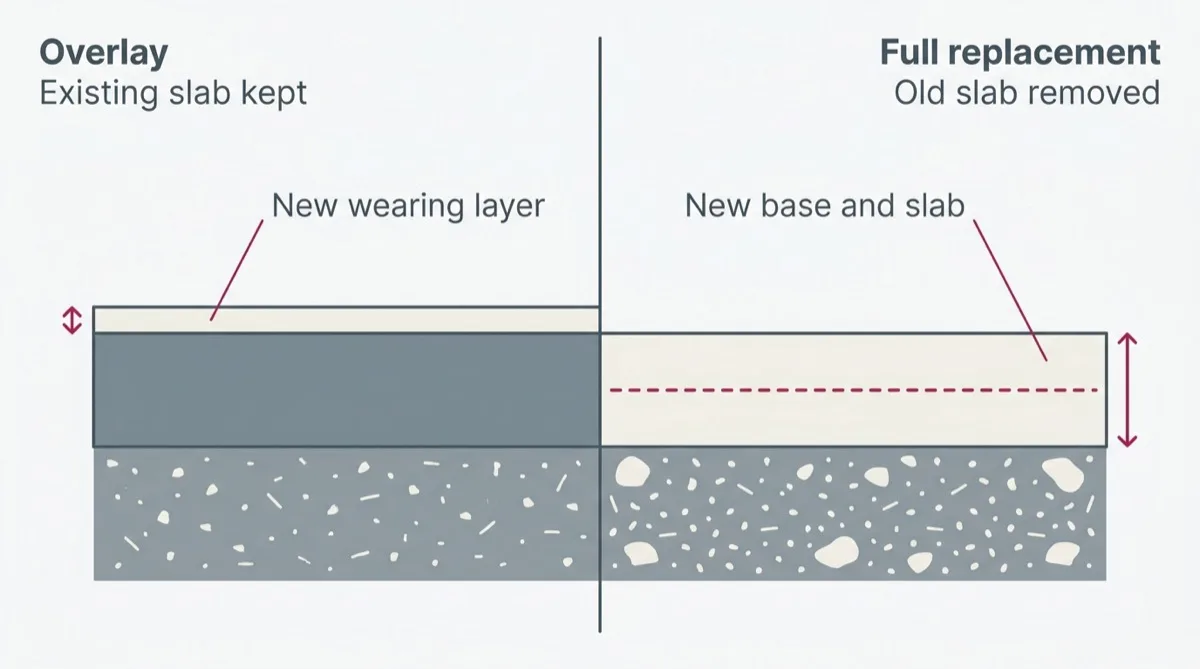
A resurfacing overlay is a polymer-modified layer, roughly a quarter inch to an inch thick, applied over a sound existing surface. It renews the wearing surface and can carry a decorative finish, but it adds no structural capacity, because it is bonded to the slab rather than replacing it.
The economics are the reason it is worth considering. Nusite Group quotes resurfacing overlays at $4 to $8 per square foot against $12 to $18 per square foot for full tear-out and replacement, so an overlay runs a fifth to two thirds of the replacement cost when the base slab is structurally sound. Toronto Concrete Repairs prices a decorative stamped or broom-finish overlay higher, at $8 to $15 per square foot, for slate, stone or brick patterns applied while repairing.
On a porch specifically, Toronto Concrete Repairs publishes three distinct tiers that are worth knowing before a quote arrives: resurfacing on a sound base at $2,500 to $4,500 for two to three days of work, a complete restoration covering steps, surface and railings together at $5,000 to $8,000 for three to five days, and a full rebuild or replacement at $8,000 to $15,000 or more for one to two weeks.
One caution on overlays in this climate. They are a surface, and surfaces in the GTA fail through freeze-thaw and salt. A penetrating sealer is the standard follow-up: Nusite Group describes resurfacing products that include penetrating sealers creating a protective barrier against salt infiltration, and Green Building Canada prices professional sealing at $1 to $2 per square foot.
Lifting: when the concrete is fine and the ground is not
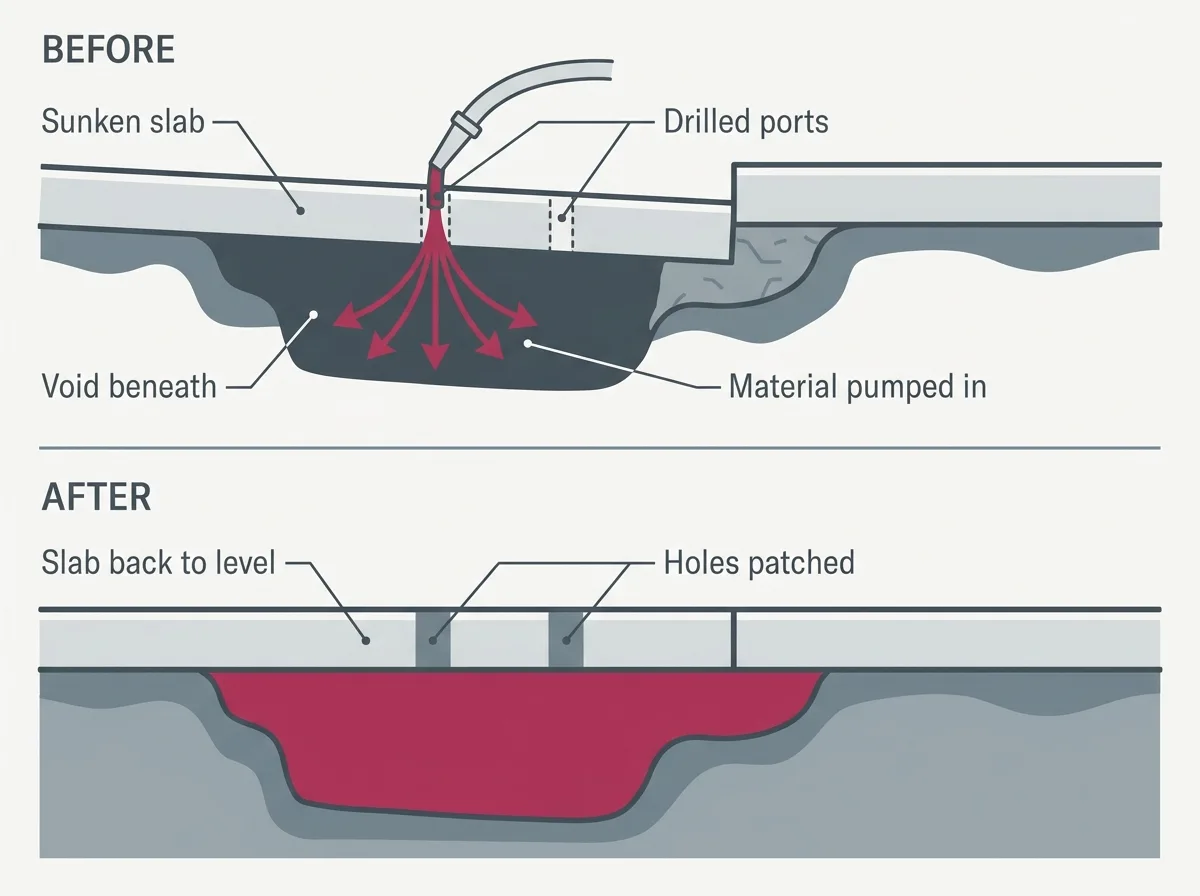
A slab that has sunk but is otherwise intact is the case people most often over-treat. The concrete has not failed. A void has opened underneath it, usually from soil settling or washing out, and the slab has followed the void down. Filling that void and pushing the slab back up restores the height without touching the concrete.
Toronto slab-lifting contractors do not generally publish per-square-foot rates, so the defensible number is a per-job one: Toronto Concrete Repairs prices a residential levelling job on a walkway or porch slab at $1,200 to $2,500. Polyurethane foam lifting costs more than traditional mudjacking but works in colder temperatures.
Timing matters more here than on most concrete work. Levelling is best scheduled after the spring thaw, so the slab is lifted against settled grade rather than against ground that is still frost-heaved and about to drop again.
Replacement: when starting over is the cheaper answer
Replacement is the right call when the slab has lost structural integrity, when it has broken into pieces that move separately, or when a base that was never adequate keeps producing the same settlement after each repair. Paying twice for an overlay that fails in three years costs more than doing it once.
The number to anchor on is Nusite Group's $12 to $18 per square foot for full tear-out and replacement, against $4 to $8 for an overlay. Demolition and haul-away of the old surface is a separate line, priced by MCL Concrete at $1 to $2 per square foot, and more where disposal access is awkward.
One important boundary: routine repair work on private property, including parging, crack injection, resurfacing overlays and slab lifting, does not need a Toronto building permit. Underpinning or structural alteration of a foundation is a different matter and requires a building permit with drawings sealed by a professional engineer. If a contractor proposes structural work as though it were a repair, that permit question is the one to ask.
Getting comparable quotes on a repair
Repair quotes are harder to compare than new-build quotes, because the scope is genuinely uncertain until someone looks underneath. That makes the assessment the important part of the visit, and it is fair to ask what the contractor found rather than only what they propose.
Prices also legitimately diverge here. On foundation crack injection, DryShield publishes $750 to $1,000 per crack for polyurethane and $750 to $1,500 for epoxy, while Leaquida Waterproofing quotes $1,500 to $3,000 per interior seam and $2,500 to $4,500 for diagonal cracks needing carbon-fibre staples. Those are different methods and different scopes, not one price being wrong, which is why comparing method to method matters more than comparing totals.
ConcreteFinder lists 93 GTA companies under concrete repair and levelling, scored on a published method rather than on payment. If you are still working out what the damage means, our guide on why concrete cracks in Toronto covers how to read it.
- Ask what the contractor found under the slab, not only what they propose to do on top of it.
- Ask whether the base slab is sound, in those words, before agreeing to any overlay.
- Compare method against method on crack repair, since polyurethane, epoxy and exterior excavation are different jobs.
- Confirm whether a sealer is included after resurfacing, and at what rate.
- For a sunken slab, ask whether lifting was considered before a repour was quoted.
Frequently asked questions
Can I resurface a cracked concrete driveway?
It depends entirely on whether the slab underneath is structurally sound. An overlay bonds to the existing concrete and adds no structural capacity, so it works over a sound slab with a worn surface and fails over a slab that has broken into independently moving pieces. That assessment has to happen before the quote, not after.
How much cheaper is resurfacing than replacing?
Roughly half, where an overlay is appropriate. Nusite Group quotes resurfacing overlays at $4 to $8 per square foot against $12 to $18 per square foot for full tear-out and replacement. Demolition and haul-away of the old surface adds $1 to $2 per square foot according to MCL Concrete.
My walkway slab has sunk. Does it need replacing?
Not necessarily. If the concrete itself is intact and it has simply dropped, that is a void underneath rather than a failure of the slab, and lifting restores the height. Toronto Concrete Repairs prices a residential levelling job on a walkway or porch slab at $1,200 to $2,500. Schedule it after the spring thaw so the slab is lifted against settled grade.
Do I need a permit to repair concrete in Toronto?
Not for routine repair on private property. Parging, crack injection, resurfacing overlays and slab lifting do not need a Toronto building permit. Underpinning or structural alteration of a foundation does, and it requires drawings sealed by a professional engineer. Work touching the City boulevard, sidewalk or curb needs a separate right-of-way approval.
Why are two repair quotes so far apart?
Usually because they are quoting different methods for the same symptom. On foundation cracks, DryShield publishes $750 to $1,000 per crack for polyurethane injection while an exterior excavation and membrane repair runs $3,000 to $5,500 per crack according to RenoQuotes. Both are real prices for real work. Compare what each one proposes to do before comparing the totals.
Related reading
How ConcreteFinder is paid, and who wrote this
This guide was researched and written by the ConcreteFinder Research Team, published on August 20, 2026. Every figure above was re-opened at the page it came from on the day this went live, and each one names that source in the sentence that uses it. Every Greater Toronto Area concrete business on this site is listed free, and no company can pay for a position in the rankings or for a mention in an article. What ConcreteFinder does and does not charge for is set out on our page for contractors, and money is kept apart from the rankings on purpose. The ranking formula is published in full on our methodology page, and if a figure here is wrong we would rather hear about it, through contact.
Compare Greater Toronto Area concrete companies
No obligation. We match you with exclusive, local pros, so you compare and choose.