Why a Small Concrete Job in Toronto Still Costs Thousands
By ConcreteFinder Research TeamPublished 8 min read
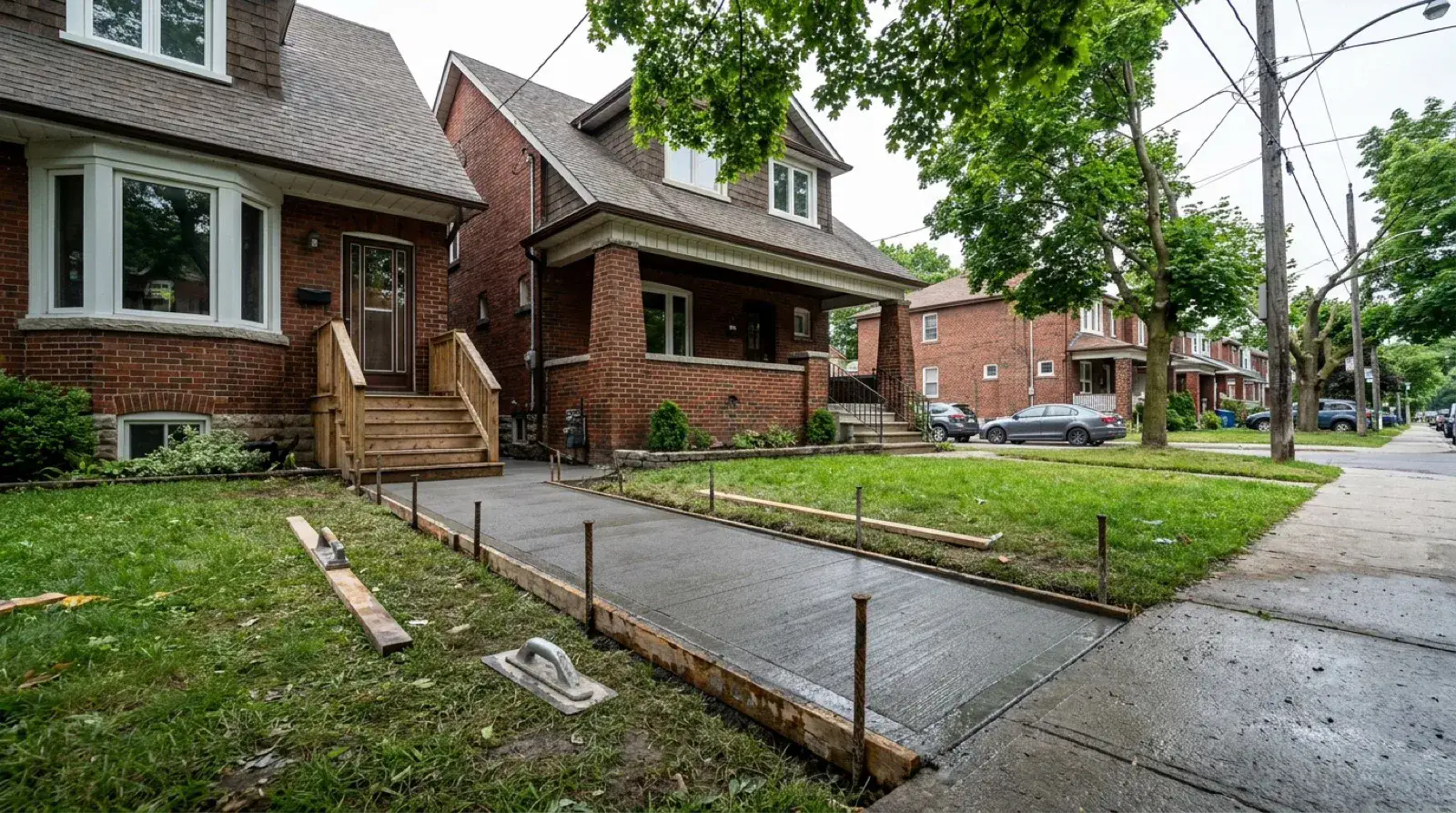
Ask three GTA contractors to price a four-metre walkway and the quotes will not read like a walkway. They come back as a flat number that seems unrelated to the size of the job. Homeowners usually read that as a brush-off. It is not.
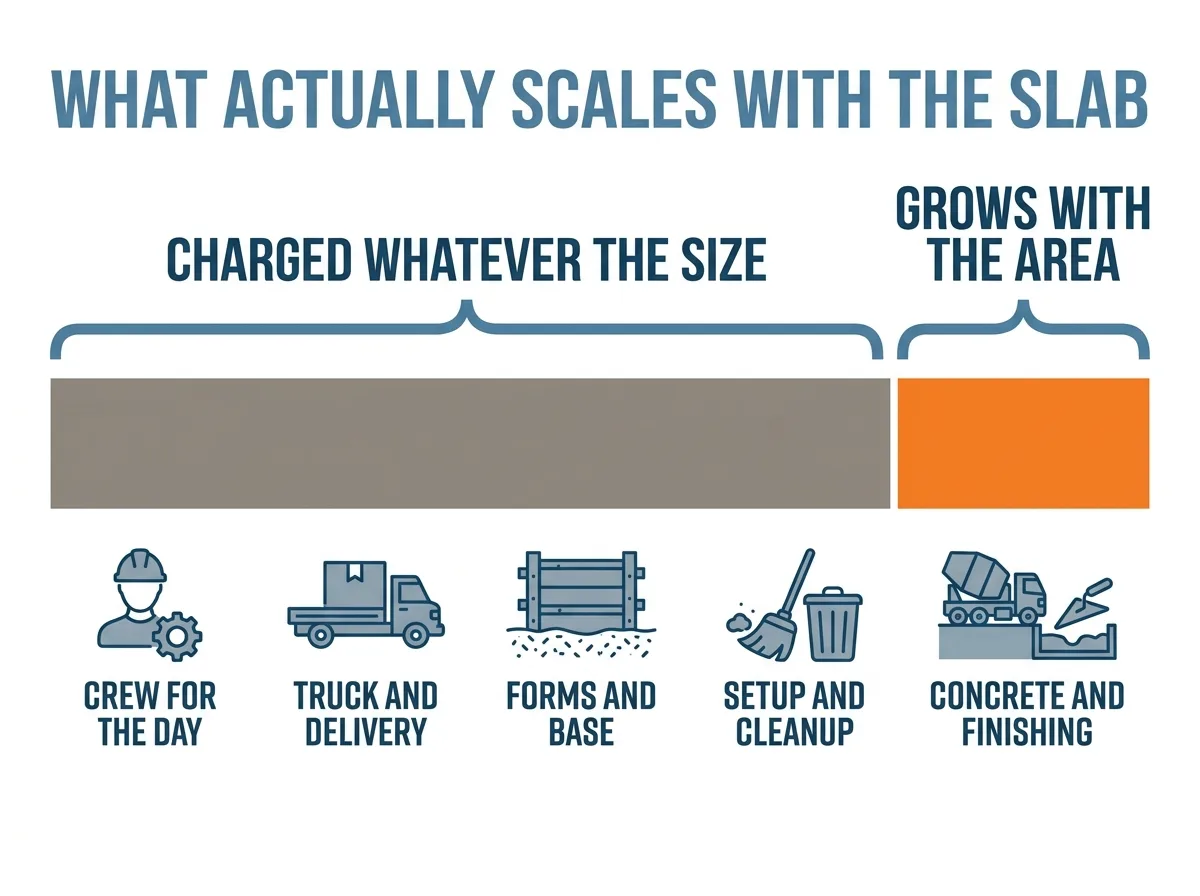
Almost everything that makes a concrete pour expensive happens before anyone looks at how big it is. A crew is booked for the day. A truck is ordered from a plant with a minimum load. Forms are built, a base is prepared, machinery arrives. Those costs barely move between a four-metre walkway and a two-car driveway. This guide sets out where the floors sit, which jobs escape them, and what actually reduces the number.
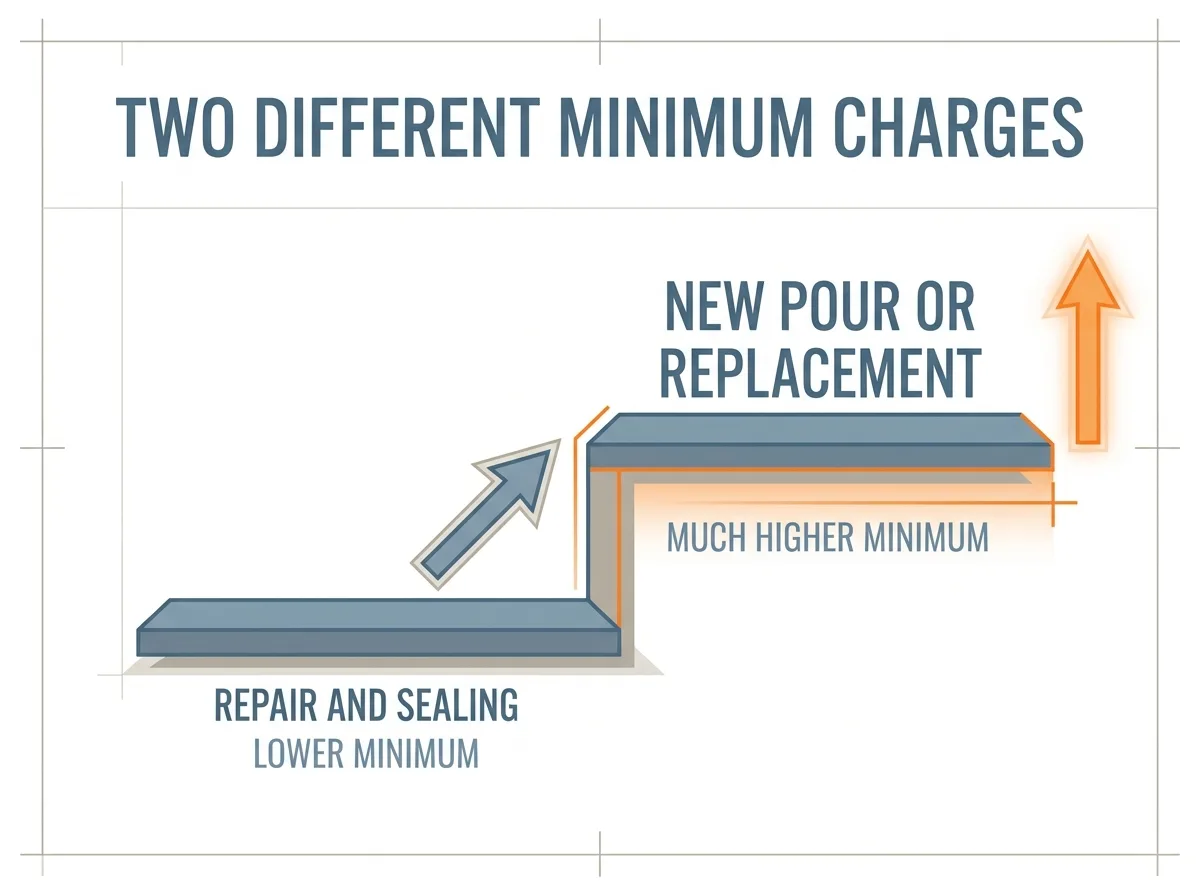
There are two different price floors, and they are far apart
The first floor applies to new flatwork: pouring something that is not there yet, or tearing out and replacing something that is. Nice Guy Concrete publishes theirs directly, describing a minimum project investment of $5,500 that applies regardless of project size. Their stated reason is that a small driveway still needs the same equipment, crew and setup time as a larger one.
The second floor applies to repair: sealing a crack, patching a step whose surface has flaked away, lifting a slab that has settled. That work needs a technician and materials rather than a crew and a truck, and it prices accordingly.
Toronto Concrete Repairs gives a sense of where that floor sits, and its own page does not agree with itself. Its Average Costs table prices a day of minor crack sealing at $600 to $900. Its services list prices crack sealing and injection from $300 to $1,200 depending on extent. The same split runs through spall repair, where flaked surface concrete is chipped out and replaced: $400 to $1,500 in one table, $1,000 to $1,500 in the other.
ConcreteFinder's own cost research puts the effective GTA call-out minimum at roughly $500 to $900, which sits inside that spread. That figure is ours rather than a published one, so treat it as a working estimate and ask each contractor for theirs.
Which floor your job sits on is therefore the most consequential question in the whole conversation, and it is settled by whether the concrete is being replaced or treated. Our guide on repairing, resurfacing or replacing concrete walks through how that gets decided on a slab that is already in poor condition.
The plant charges a minimum before the contractor does
Even a contractor willing to price a tiny pour by the square foot runs into the supplier. 2AZ Group states that most GTA plants hold a three cubic metre minimum: order less and you pay full price for three anyway, plus a short-load surcharge of $50 to $80 per cubic metre under the minimum.
Canada Building Materials publishes it as a delivery charge, a flat fee per load rather than a surcharge: $175.00 for a load of 3.2 to 4 cubic metres, $300.00 for 1.2 to 3 cubic metres and $400.00 for a single cubic metre, with one cubic metre as the minimum load they will deliver at all. None of those charges gets smaller as the job does.
There is a real alternative below that volume, and it is bags. Builders Ontario puts the break-even at roughly 0.75 to 1 cubic metre, under which bagged mix usually wins once the delivery charge is counted. Our guide on what a cubic metre of concrete costs sets out both sides of that line, and the bag calculator works out the bag count for a given slab.
What the fixed part of the day actually pays for
It helps to see the list, because homeowners rarely do. Before any concrete is placed, a small job still needs the existing surface removed and hauled away and the ground excavated to depth. Then a granular base goes in, meaning crushed stone spread and compacted to carry the slab. Then forms are built and staked, reinforcement is placed, and a delivery is scheduled to arrive inside a window when the crew is standing there ready.
Some of those have published per-unit prices, which shows how small the variable part is. Nice Guy Concrete lists tearout and disposal of an old asphalt driveway at $2 to $3 per square foot and old concrete at $3 to $5 per square foot. On a four metre walkway those lines are worth a couple of hundred dollars. The day of crew time around them is not.
Access adds another fixed cost on a lot where the truck cannot reach the forms. 2AZ Group lists half-day rates of $800 to $1,200 for a trailer-mounted line pump and $1,200 to $1,800 for a mid-size boom pump. On a narrow Toronto lot with a back-garden pad, the pump can cost more than the concrete.
What actually brings the number down
Not the rate. A contractor who drops a project minimum to win a small job either loses money or takes it out of the scope somewhere. The lever that works is the denominator: get more work out of the same fixed costs.
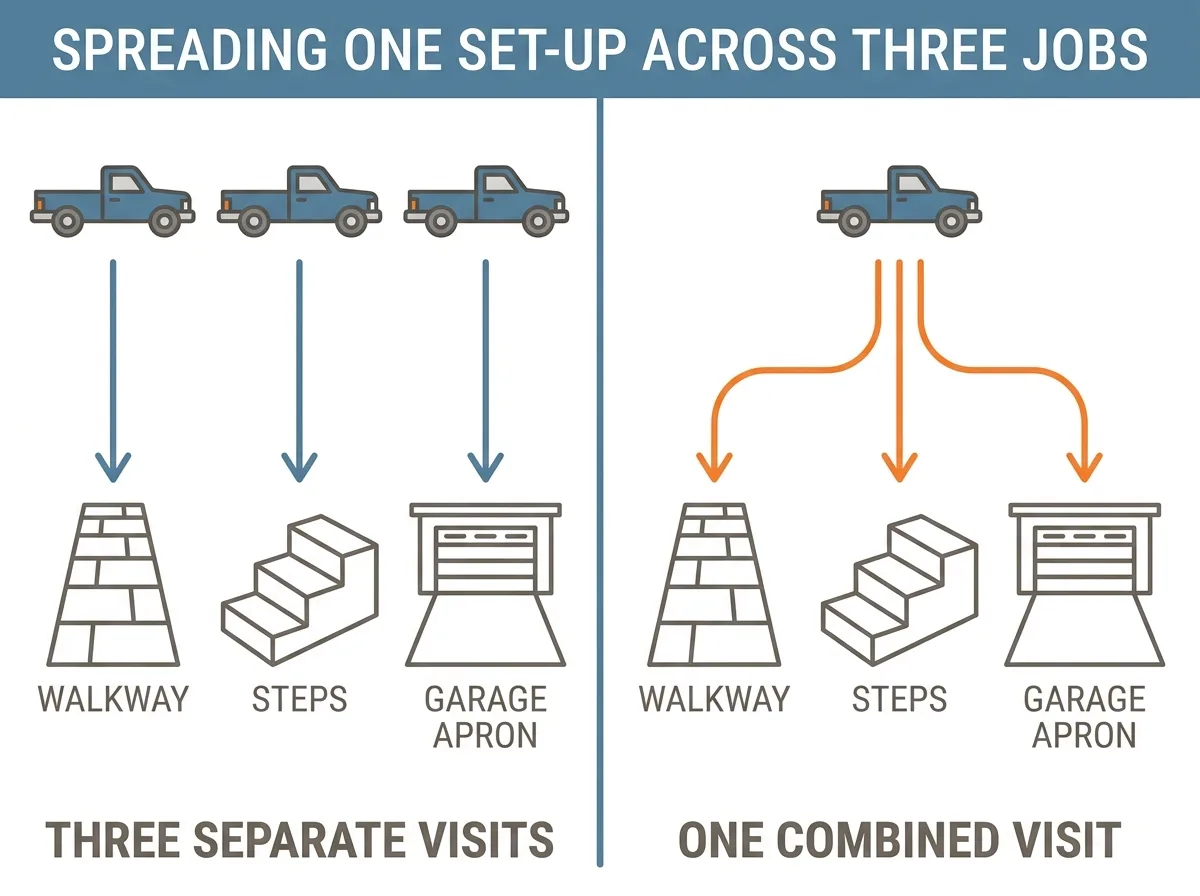
Combining jobs is the strongest version of that. Say the walkway, the front steps and the garage apron, the strip of concrete between the garage door and the driveway, are all going to need doing within a few years. Having them done in one visit spreads a single mobilisation, the cost of getting a crew, a truck and equipment to your address at all, across three jobs. So does coordinating with a neighbour on the same street, which lets one crew and one truck serve two properties in a single booking.
It is also worth checking honestly whether the job is a repair rather than a replacement, because that moves it to the lower floor. An overlay, a thin new layer bonded over a slab that is still sound underneath, is the usual middle option. Toronto Concrete Repairs prices minor crack sealing at $600 to $900 for a day of work, moderate spall repair at $1,000 to $1,500, mudjacking or levelling at $1,200 to $2,500 and surface resurfacing at $2,500 to $4,500. Those are whole-job prices, and every one of them sits below Nice Guy Concrete's published $5,500 minimum for a new pour.
- Ask directly what the contractor's minimum project charge is, before describing the job.
- Ask whether spall repair, where flaked surface concrete is chipped out and replaced, would do instead of a new pour.
- Ask whether the work can be done as a repair, or as a thin overlay bonded over the old slab, rather than a replacement.
- Batch several small jobs into one visit rather than spacing them over three years.
- For anything under roughly a cubic metre, price bagged mix as a real alternative.
- Ask whether a pump is needed, and whether it is inside the quoted price.
Who to ask, and how many
Minimums vary between companies and most do not publish them, so the only way to find the range is to ask more than one. ConcreteFinder indexes 770 concrete companies across the GTA, including 146 listed under patios and walkways and 83 under concrete repair and levelling.
That is a deep enough field that three quotes on a small job is realistic rather than optimistic, and it is worth getting all three before concluding that the first number was unreasonable. The concrete patio cost guide and the concrete repair cost guide carry the full sourced price tables for each side of the line.
A minimum charge is not a sign of a contractor who does not want your work. It is a sign of one who has priced their day honestly. The quote to treat carefully on a small job is the unusually low one, and the question to ask about it is what has been left out of the scope.
Frequently asked questions
Why won't a contractor quote my small concrete job by the square foot?
Because most of the cost is not per square foot. A crew, a truck, forms and a compacted base are needed whether the slab is four metres or forty. Nice Guy Concrete publishes a $5,500 minimum project investment and states it applies regardless of project size, for exactly that reason.
What is the minimum charge for concrete work in Toronto?
It depends which kind of work it is. For a new pour or a replacement, Nice Guy Concrete's published minimum project investment is $5,500. For repair, Toronto Concrete Repairs prices a day of minor crack sealing at $600 to $900 and lists crack sealing and injection from $300 to $1,200 depending on extent. ConcreteFinder's own cost research puts the effective call-out minimum at roughly $500 to $900, a working estimate of ours rather than a published figure.
Can I just order a small amount of concrete myself?
Yes, but the plant has a minimum too. Canada Building Materials sets a one cubic metre minimum load and charges $400.00 to deliver it, or $300.00 for a load of 1.2 to 3 cubic metres. 2AZ Group reports a three cubic metre order minimum at most GTA plants with a $50 to $80 per cubic metre surcharge under it.
Is it cheaper to do several small concrete jobs at once?
Usually, yes. The fixed part of the cost is a crew day, a delivery and a mobilisation, and those are charged once per visit rather than once per slab. Combining a walkway, steps and an apron into one booking spreads a single set of fixed costs across three pieces of work.
How much does it cost to fix one cracked concrete step in Toronto?
Toronto Concrete Repairs prices minor crack sealing at $600 to $900 for a day of work, and separately lists crack sealing and injection from $300 to $1,200 depending on extent. Its two tables do not agree with each other, which is worth knowing before you treat any one of those numbers as the floor. Ask which of them applies to your crack.
Sources
Every figure in this article is either counted from ConcreteFinder's own index of Greater Toronto Area concrete companies or copied from one of the pages below, which is named in the sentence that uses it.
- Nice Guy Concrete - Ontario driveway cost calculator 2026 (minimum project investment, tearout rates)
- 2AZ Group - The Real Cost of Concrete Work in the GTA in 2026 (plant minimum, short-load surcharge, pump hire)
- Canada Building Materials - GTA ready-mix price list (minimum load size and per-load charges)
- Toronto Concrete Repairs - concrete porch repair costs (per-job repair prices)
- Builders Ontario - Concrete Calculator Ontario 2026 (the bagged-mix break-even volume)
How ConcreteFinder is paid, and who wrote this
This guide was researched and written by the ConcreteFinder Research Team, published on September 17, 2026. Every figure above was re-opened at the page it came from on the day this went live, and each one names that source in the sentence that uses it. Every Greater Toronto Area concrete business on this site is listed free, and no company can pay for a position in the rankings or for a mention in an article. What ConcreteFinder does and does not charge for is set out on our page for contractors, and money is kept apart from the rankings on purpose. The ranking formula is published in full on our methodology page, and if a figure here is wrong we would rather hear about it, through contact.
Compare Greater Toronto Area concrete companies
No obligation. We match you with exclusive, local pros, so you compare and choose.