What a Cubic Metre of Concrete Actually Costs in Toronto
By ConcreteFinder Research TeamPublished 9 min read
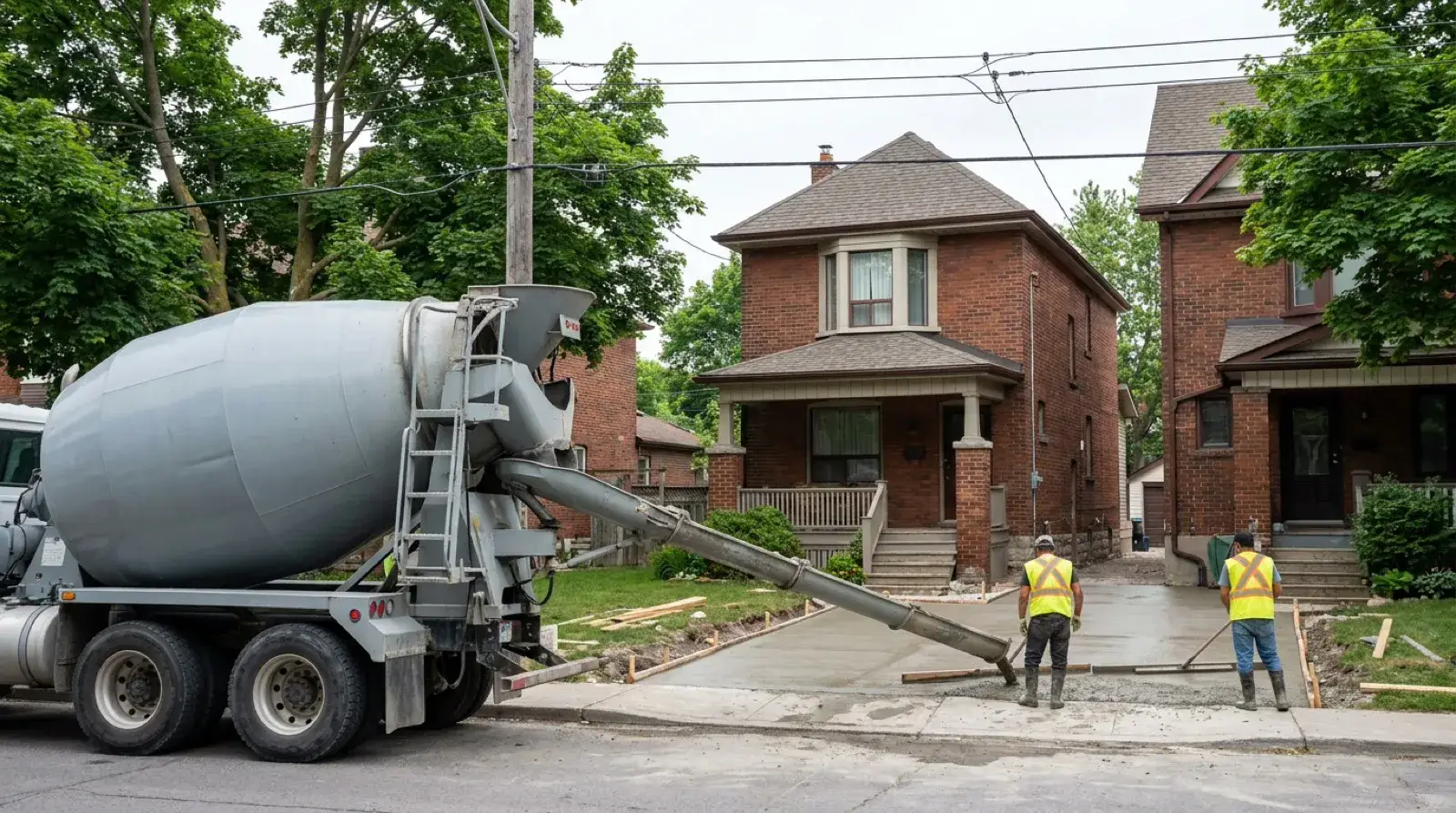
Concrete in Canada is sold by the cubic metre. Search results, contractor forums and half the calculators online still quote cubic yards, which is the main reason two quotes for the same driveway can look like they are describing different materials. The first thing worth fixing is the unit.
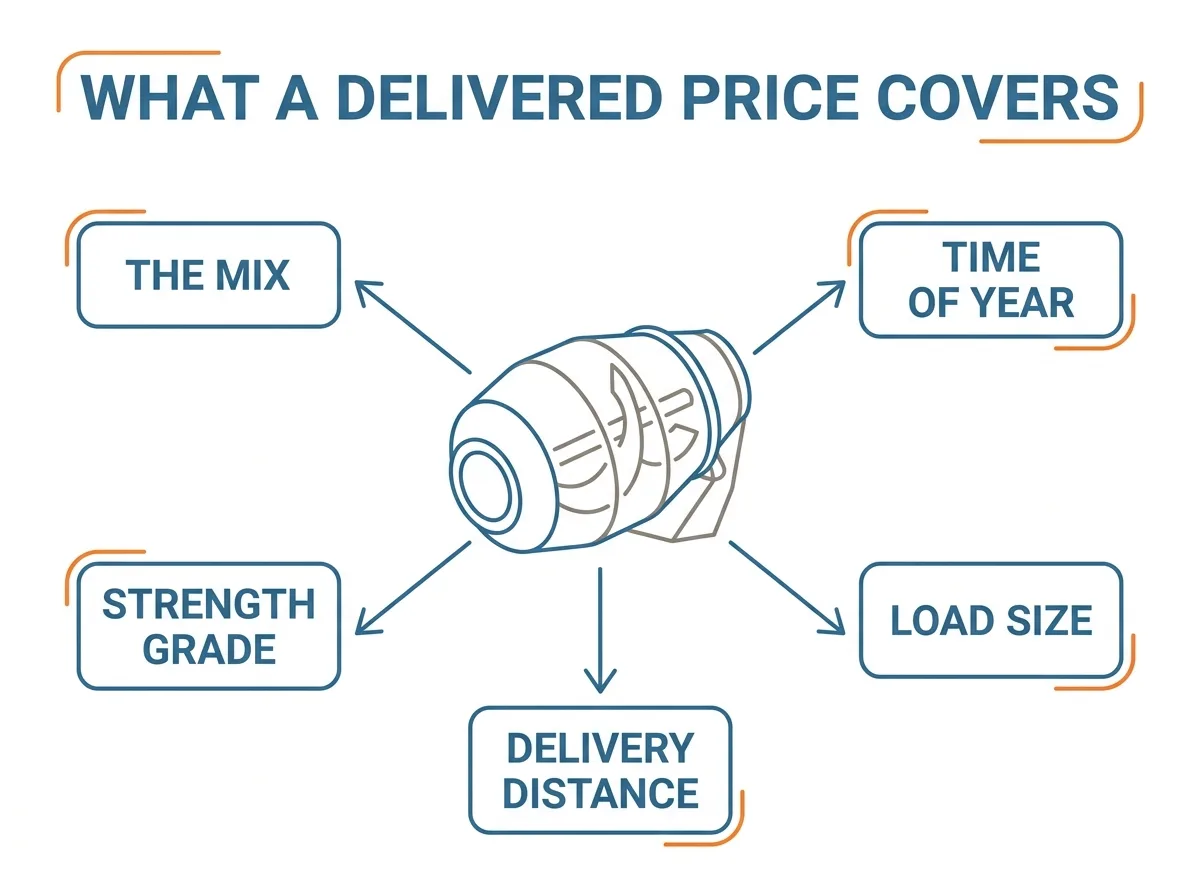
The second is what the number covers. A plant's published rate is for the concrete in the drum, at the plant's own delivery radius, during normal hours, at a normal load size. Almost every surprise on a small residential pour comes from one of those four conditions not holding, and each of them has a published price.
What the plants actually charge per cubic metre
Three Canadian sources publish a GTA or Ontario figure, and they do not agree, so this guide prints each one rather than averaging them into a number nobody published.
Canada Building Materials publishes a dated GTA list price by strength. Strength is quoted in MPa, which is how hard the concrete is when it has finished curing, and a higher number costs more. Their list runs $230.00 per cubic metre for 10 MPa, $240.00 for 20 MPa, $245.00 for 25 MPa, $255.00 for 30 MPa and $270.00 for 35 MPa, effective January 15, 2026. That is the cleanest figure available, because it is a plant's own published list rather than a contractor's estimate.
Builders Ontario states that ready-mix in Ontario runs about $175 to $225 per cubic metre delivered in 2026, with most residential pours landing near $200 for standard 25 to 32 MPa mixes. 2AZ Group publishes a GTA table that runs higher: $230 to $260 for 20 MPa, $250 to $290 for 25 MPa, $270 to $320 for 30 MPa and $290 to $350 for 32 MPa.
Read together, a residential GTA pour of 25 to 32 MPa lands somewhere between $175 and $350 per cubic metre. The spread is not a delivery question. Builders Ontario says its range is delivered. 2AZ Group says its own are plant-gate prices, meaning the concrete before the trip is counted, with standard delivery inside a 30 kilometre radius. What differs is who was surveyed and when.
Cubic metre or cubic yard, and why the number moves
A cubic yard is smaller than a cubic metre, so a price quoted per yard is always the lower-looking number for the same concrete. The size of the gap is not a matter of opinion and you do not have to take anyone's word for it.
Basalite Canada prints both figures for the same 25 kilogram sack: 86 sacks fill one cubic metre and 66 sacks fill one cubic yard. From that source's own two numbers, a cubic yard is roughly three quarters of a cubic metre. That is the ratio to hold in your head when a quote switches units halfway through.
If you have measured your slab in feet and inches, our concrete volume calculator converts it and shows the result in both units, so nothing gets ordered against the wrong one. The practical habit is simpler than the arithmetic: ask every supplier and every contractor to quote in cubic metres, and compare only after they all have.
The charges that ride on top of the per-metre rate
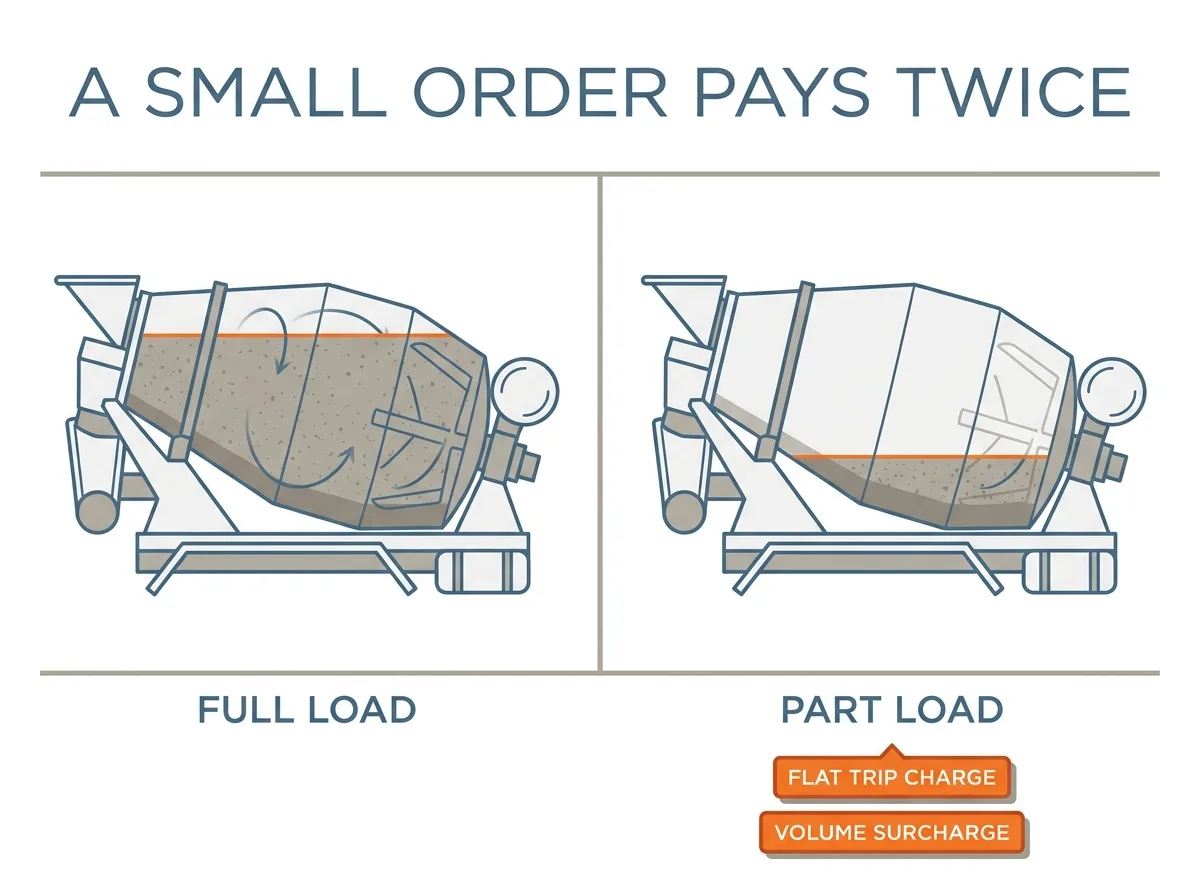
This is where a backyard pad stops resembling the list price. Canada Building Materials sets a minimum load size of one cubic metre and prices the small ones as a flat delivery charge per load: $175.00 for a load of 3.2 to 4 cubic metres, $300.00 for 1.2 to 3 cubic metres, and $400.00 for a single cubic metre. That charge is on top of the concrete. The same list adds cost recovery charges of $7.00 per cubic metre for environmental and $2.00 per cubic metre for fuel, on every load whatever its size.
2AZ Group describes the same behaviour from the buyer's side: most plants hold a three cubic metre minimum, you pay for three whether you take three or not, and a short-load surcharge of $50 to $80 per cubic metre applies under the minimum. The same page prices delivery beyond a 30 kilometre radius at $8 to $15 per kilometre.
Access is the other multiplier. Where a truck cannot reach the forms, concrete gets pumped along a hose instead of running down a chute. 2AZ Group lists half-day rates of $800 to $1,200 for a trailer-mounted line pump, $1,200 to $1,800 for a mid-size boom pump and $1,800 to $2,500 for the longest reach. On a narrow Toronto lot with the pour happening in the back garden, that is a line item to ask about before the truck is booked, not after it arrives.
Season carries its own charge. Canada Building Materials adds $22.00 per cubic metre for winter handling from November 1 to April 30 inclusive, and 2AZ Group puts winter surcharges at $20 to $40 per cubic metre from November through March. Our guide on when to book concrete work in the GTA covers what the season does to a quote.
Bags or a truck: where the line actually sits
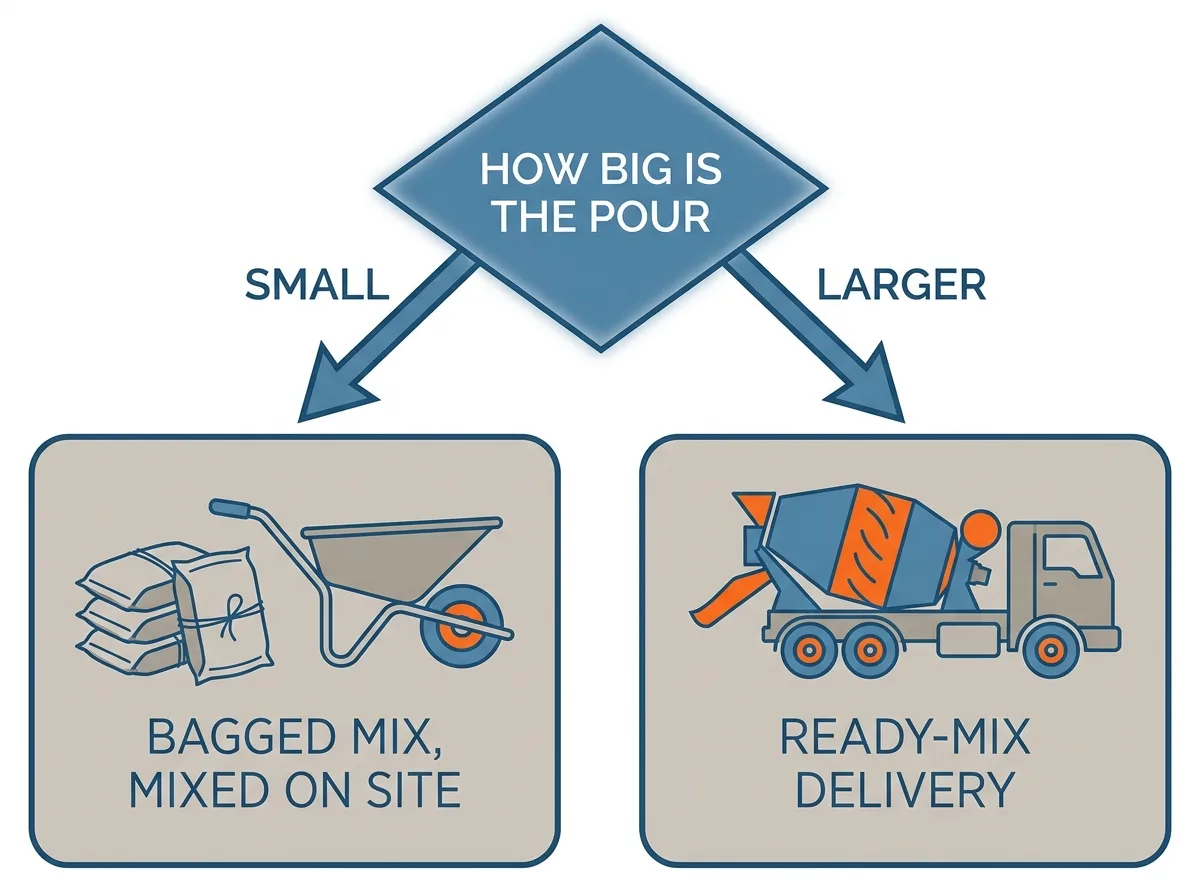
For a fence post or a small pad, bags are the obvious answer, and for a driveway they are obviously wrong. The interesting question is where the crossover is, and Builders Ontario answers it directly: the break-even is often around 0.75 to 1 cubic metre.
The arithmetic behind that is a yield figure, and the sack size matters. Basalite states that 86 of its 25 kilogram sacks fill one cubic metre. A 30 kilogram bag holds more, and the two manufacturers disagree slightly on how much. Sakrete Canada states half a cubic foot per bag, which works out at about 71 bags to the cubic metre. Target Products, which makes QUIKRETE in Canada, states 0.52 cubic feet, which gives about 68. Either way it is a lot of bags to buy, carry and mix.
Bag prices read off three Canadian retailers' own listings run $6.20 to $7.58 for a 30 kilogram bag before tax: $6.20 at King Construction Supplies in Brampton, $7.29 at Chamberlain Timber Mart in Gravenhurst, and $7.58 at Housing Guards in Scarborough.
Below roughly three quarters of a cubic metre, bags usually win once the partial-load charge is counted, because that charge does not shrink with the order. Above it, the truck wins and keeps winning. Our bag calculator works out the bag count for a given slab.
How much to order, and why you always order extra
Running short in the middle of a pour is the expensive failure. A second delivery arrives after the first load has started to set, and the seam between the two is a cold joint: a plane through the slab where the concrete never bonded to itself. Ordering slightly long costs a small amount of concrete.
Builders Ontario advises adding 5 to 10 percent to the measured volume for a simple slab, and 10 to 15 percent for complex shapes, footings with over-dig, or anything with a lot of edges. Over-dig is the extra soil that comes out when a trench collapses slightly at the sides, and the extra concrete then fills it. That is the reason the second number is higher: an excavated footing is never exactly the shape that was drawn.
Measure the slab, add the allowance, then convert to cubic metres and order in whole increments the plant will actually deliver. Contractors do this as a matter of course; it is worth checking the number on their quote against your own.
- Measure length, width and thickness in the same unit before converting anything.
- Add 5 to 10 percent for a simple rectangular slab, and 10 to 15 percent for footings and complex shapes, per Builders Ontario.
- Ask whether the quote is plant-gate, meaning the concrete alone before the trip is counted, or delivered.
- Ask what the plant's minimum load is and what a part load costs, before choosing the pour date.
- Ask whether a pump is in the price or extra, if the truck cannot reach the forms.
What this means when you are reading a contractor's quote
Material is a minority of a finished concrete price. A driveway quote also covers tearing out what is there, excavation, a granular base of crushed stone compacted to carry the slab, forms, reinforcement, the pour, finishing, joint cutting, cleanup and disposal. Most of that is labour. Our concrete work cost guide carries the full sourced table for the GTA.
Knowing the per-metre rate is still worth it for one reason: it tells you whether a quote is in the right postcode. If a contractor's line for concrete is far above the plant rate for the volume your slab needs, that is a question worth asking, and the answer is often a legitimate one about load size, pumping or season rather than a markup.
ConcreteFinder indexes 770 concrete companies across the GTA, 540 of them under concrete contractors. Getting three quotes and comparing the scope rather than the bottom line is still the single most useful thing a homeowner can do here, and the per-metre rate is one of the few pieces of that scope you can check yourself.
Frequently asked questions
How much does a cubic metre of concrete cost in Toronto?
Canada Building Materials' GTA list price effective January 15, 2026 is $245.00 per cubic metre for 25 MPa, $255.00 for 30 MPa and $270.00 for 35 MPa. Builders Ontario states a wider Ontario residential range of $175 to $225 delivered, and 2AZ Group's GTA table runs $230 to $350 by strength. Taken together, expect $175 to $350 per cubic metre delivered for a residential mix.
What is the price of concrete per yard in Ontario?
Canadian plants quote per cubic metre, not per cubic yard, so a per-yard price is usually a converted figure rather than a published one. Basalite states that 86 of its 25 kilogram sacks fill a cubic metre and 66 fill a cubic yard, so a yard is roughly three quarters of a metre. Ask for the quote in cubic metres and compare like with like.
Why is a small concrete delivery so expensive per cubic metre?
Because the trip is priced separately from the concrete. Canada Building Materials charges $300.00 for a load of 1.2 to 3 cubic metres and $400.00 for a single cubic metre, and 2AZ Group reports a short-load surcharge of $50 to $80 per cubic metre under a plant's three cubic metre minimum. Neither charge shrinks as the order gets smaller.
Is it cheaper to mix bags or order ready-mix?
Builders Ontario puts the break-even at roughly 0.75 to 1 cubic metre. Below that, bags usually win once the partial-load delivery charge is counted. Above it, ready-mix wins, and the gap widens quickly: Basalite states that one cubic metre takes 86 of its 25 kilogram sacks, and this site's materials data puts the same cubic metre at roughly 68 to 71 of the larger 30 kilogram bags.
How much extra concrete should I order?
Builders Ontario advises 5 to 10 percent above the measured volume for a simple slab, and 10 to 15 percent for complex shapes or footings with over-dig. Ordering short is the costly mistake, because a late second load leaves a cold joint through the slab.
Sources
Every figure in this article is either counted from ConcreteFinder's own index of Greater Toronto Area concrete companies or copied from one of the pages below, which is named in the sentence that uses it.
- Canada Building Materials - GTA ready-mix price list, effective January 15, 2026
- Builders Ontario - Concrete Calculator Ontario 2026 (delivered rate, waste allowance, bag break-even)
- 2AZ Group - The Real Cost of Concrete Work in the GTA in 2026 (rates by strength, short-load and pump charges)
- Basalite Canada - SAKRETE Concrete Mix (25 kg sack yield, sacks per cubic metre and per cubic yard)
- Sakrete Canada - Concrete Mix (30 kg bag yields half a cubic foot, the basis for the 71 bag figure)
- Target Products Ltd. (QUIKRETE Canada) - Concrete Mix (30 kg bag yields 0.52 cubic feet, the basis for the 68 bag figure)
- King Construction Supplies, Brampton ON - 30 kg concrete mix bag price
- Chamberlain Timber Mart, Gravenhurst ON - 30 kg concrete mix bag price
- Housing Guards, Scarborough ON - 30 kg concrete mix bag price
How ConcreteFinder is paid, and who wrote this
This guide was researched and written by the ConcreteFinder Research Team, published on September 17, 2026. Every figure above was re-opened at the page it came from on the day this went live, and each one names that source in the sentence that uses it. Every Greater Toronto Area concrete business on this site is listed free, and no company can pay for a position in the rankings or for a mention in an article. What ConcreteFinder does and does not charge for is set out on our page for contractors, and money is kept apart from the rankings on purpose. The ranking formula is published in full on our methodology page, and if a figure here is wrong we would rather hear about it, through contact.
Compare Greater Toronto Area concrete companies
No obligation. We match you with exclusive, local pros, so you compare and choose.