Garage Pads and Backyard Slabs in Toronto: Thickness, Base, Reinforcement and Permits
By ConcreteFinder Research TeamPublished 8 min read
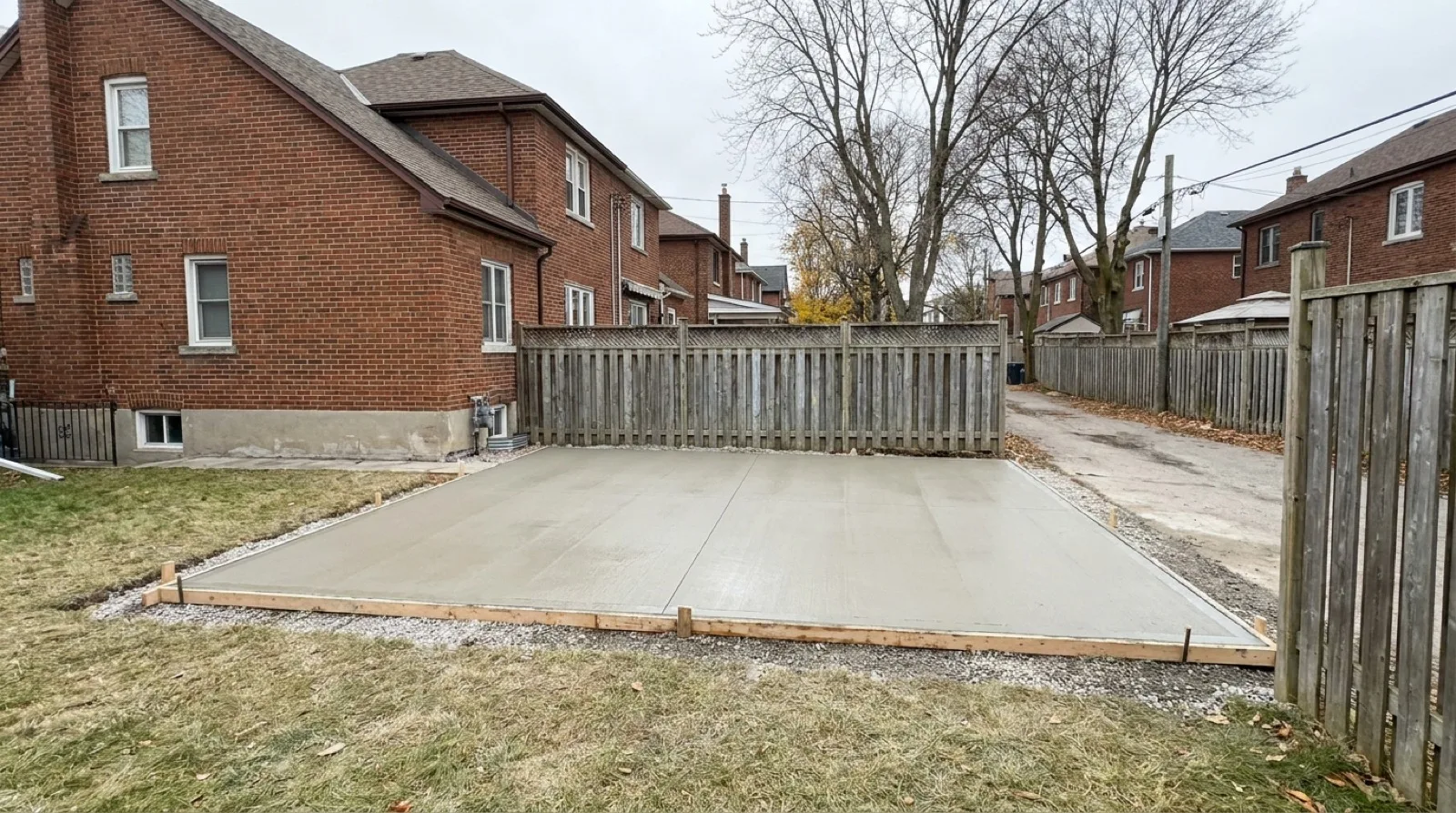
A concrete pad looks like the simplest thing a contractor can build for you, and that is exactly why quotes for one vary so widely. Everything that separates a pad that stays flat from one that cracks apart in five winters is buried before the finish goes on, so two bids for the same rectangle can describe genuinely different projects and neither is lying.
This guide is about what belongs under and inside that rectangle, and where Toronto's permit thresholds sit. The full sourced price table lives in our concrete slab cost guide; the field of contractors is at garage pads and slabs, where ConcreteFinder currently lists 10 GTA specialists alongside the 559 general concrete companies in the wider directory.
Thickness is chosen by what parks on it
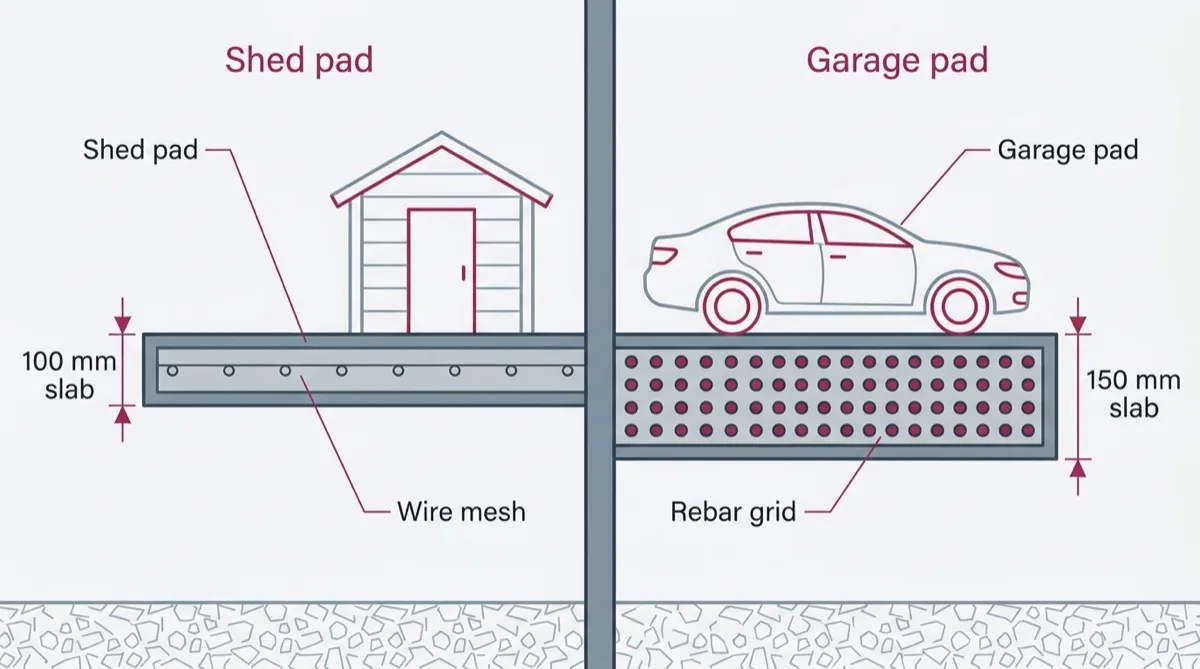
The single most consequential line in a slab quote is thickness, and it follows the load. Sheds and basement floors are commonly 4 inches. Garage pads that carry vehicles are 5 to 6 inches at 32 MPa, the air-entrained strength used for GTA freeze-thaw exposure.
That difference costs real money, not a rounding. A 6-inch slab needs roughly 50% more ready-mix than a 4-inch slab over the same area, and ready-mix in a 25 to 32 MPa residential mix runs $250 to $350 per cubic metre delivered according to 2AZ Group, with standard delivery inside a 30 km radius. So a quote that is cheaper per square foot may simply be a thinner slab.
Ask which thickness is being quoted, and ask why that thickness is right for what will sit on it. A contractor who has specified a pad for a vehicle will answer immediately. One who has not will talk about the finish instead.
The four layers you never see again
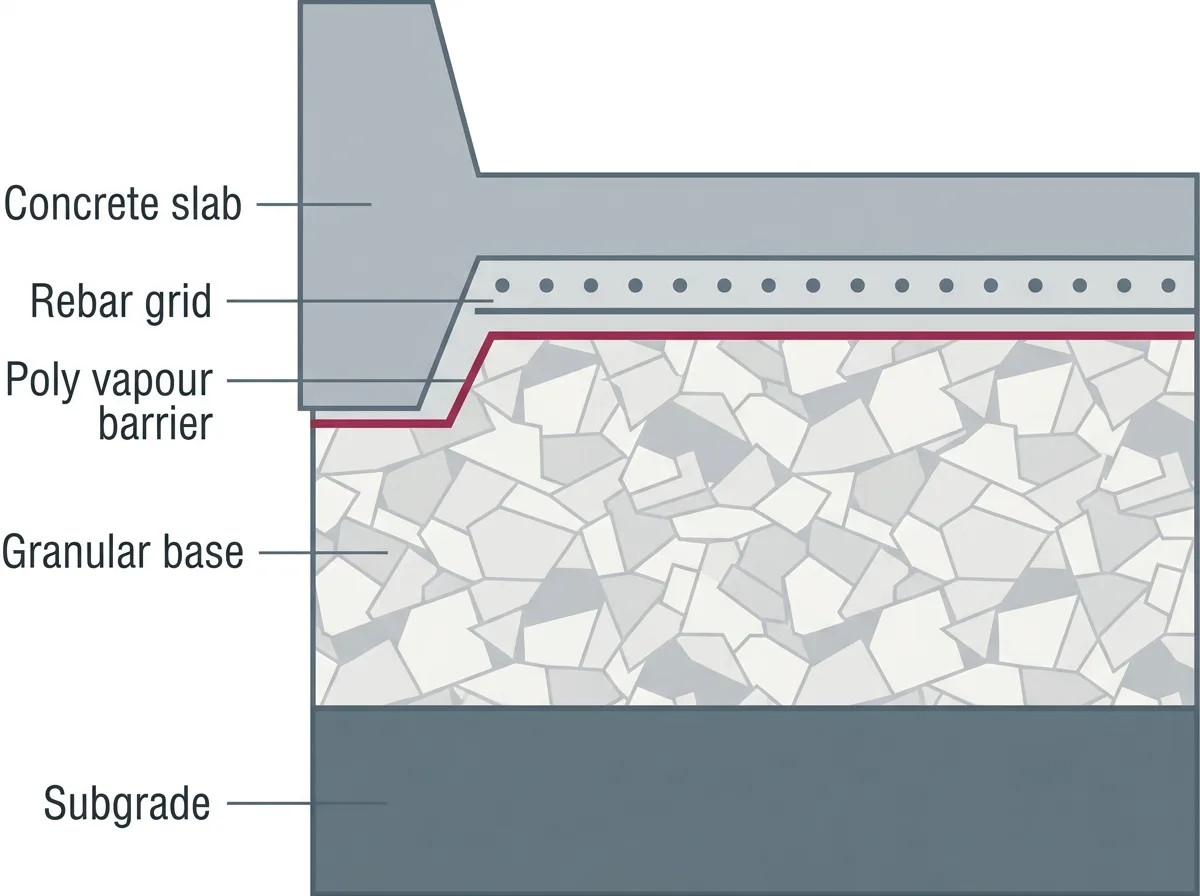
Below the concrete there are four things worth naming in a quote, and each of them has a real cost attached.
The excavation comes first, typically 8 to 12 inches, and it has to reach undisturbed ground rather than stopping at convenient. Granular A backfill then goes in and gets compacted, priced at $35 to $50 per tonne. Over that, a polyethylene vapour barrier: 6-mil poly is the standard moisture layer under new slabs, and 2AZ Group lists 10-mil poly at $80 to $120 per 1,000 square foot roll as a material cost.
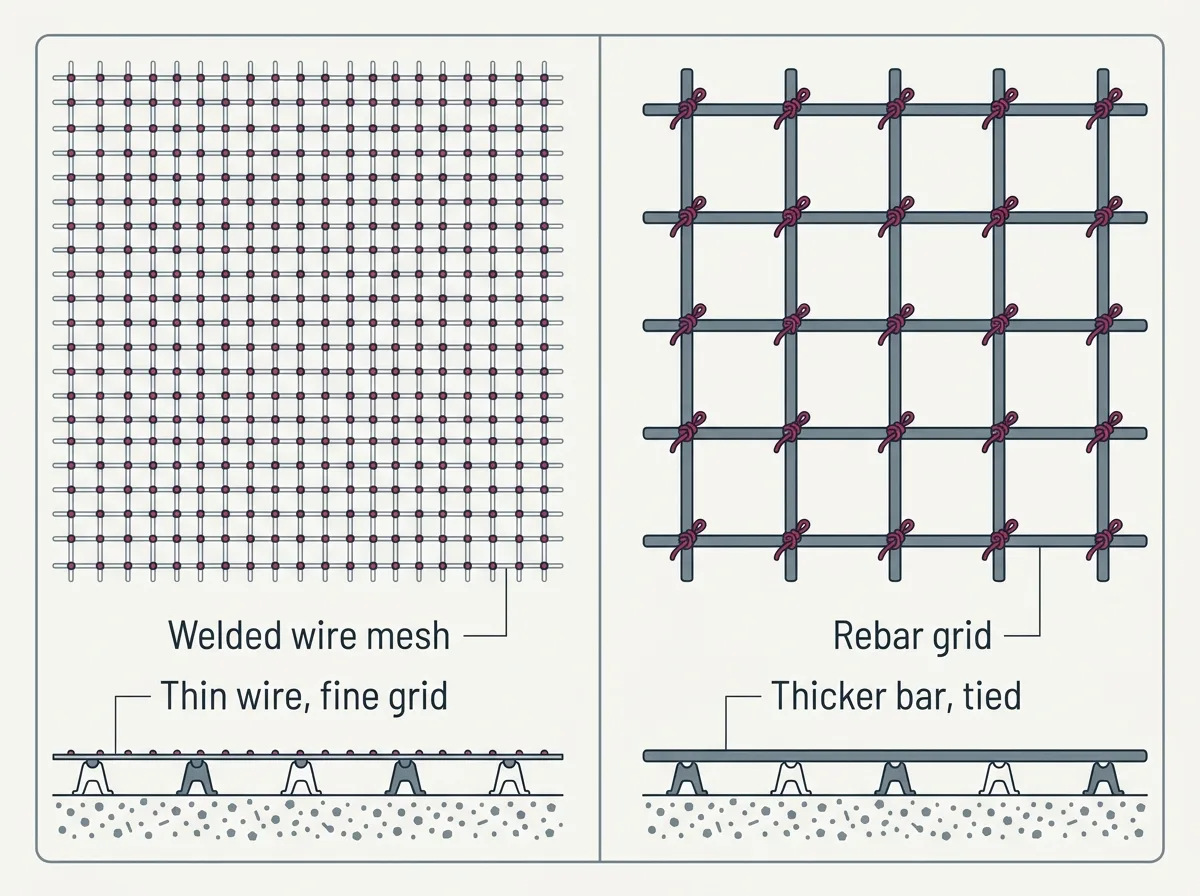
Reinforcement sits last, and this is where quotes quietly diverge. Strong Basements charges $1 per square foot for welded steel wire mesh in a basement against $8 or more per square foot for a 10 mm rebar grid in a garage, and rebar is the standard for a garage pad. Those are two different specifications, not two prices for one thing, and a bid that says only "reinforced" has told you nothing.
Under-slab insulation is optional in most cases. The Ontario Building Code does not require it for basement floors the way it does for basement walls, though R-10 rigid foam is recommended where in-floor heating is going in, and Strong Basements lists 2-inch rigid foam from $4 per square foot.
Where the permit line falls
Two thresholds do most of the work in Toronto. A detached garage, or any accessory structure over 10 m², which is about 107 square feet, needs a City of Toronto building permit. Sheds under 15 m², about 161 square feet, are exempt from a permit but still have to comply with the Zoning Bylaw. Garage-project permit fees start around $220 according to Toronto General Contractors. Because the two thresholds are stated differently for different structure types, confirm your own project directly with Toronto Building before assuming which side of the line it falls on.
Front-yard parking pads are the exception that catches people out, because they are not a permit at all. A pad is a licensed use of City property under Municipal Code Chapter 918, and many central wards, including areas south of Bloor and parts of Riverdale, have moratoriums on issuing new licences. Where they are available, City fees run $514.41 plus HST to apply, $331.13 plus HST in annual renewal and $165.56 plus HST to transfer on sale under the 2026 fee schedule, and permeable paving is required, which poured concrete generally will not satisfy.
Anything touching the boulevard, sidewalk or curb needs a right-of-way street work permit, and those are issued to licensed contractors rather than to homeowners directly. Our guide to driveway replacement permits and timing covers that side in more detail.
Access, season and the costs that are not per square foot
Toronto's older neighbourhoods put a lot of garages on rear laneways with no truck access, and that changes the job. A concrete pump truck for a tight-access pour is a flat fee of $800 to $1,200 according to 2AZ Group, and the alternative is wheelbarrow labour hours, which is not obviously cheaper.
Season is the other fixed adder. The practical GTA residential pour season is roughly April to November, and ready-mix suppliers add a $20 to $40 per cubic metre heated-concrete surcharge from November to March, per 2AZ Group. Cold-weather pours also need hoarding, heaters and accelerating admixtures, so a winter slab costs more for the same specification.
Small pads carry a premium that has nothing to do with quality. Nice Guy Concrete prices a 10 by 12 foot shed pad at $1,800 to $3,000 including excavation, gravel base, reinforcement and concrete, which works out well above the per-square-foot rate of a larger pour, because mobilization, forming and the ready-mix minimum load are fixed regardless of size.
- Pump truck for a rear-lane or basement pour: $800 to $1,200 flat, per 2AZ Group.
- Heated ready-mix surcharge from November to March: $20 to $40 per cubic metre, per 2AZ Group.
- Granular A base material: $35 to $50 per tonne.
- Breaking out an existing slab starts at $14 per sq ft for a basement and $20 per sq ft for a garage, per Strong Basements.
- HST at 13% applies on top of quoted contract prices, and there is no rebate for replacing a pad or slab.
How to compare two pad quotes
Installed garage-slab pricing genuinely conflicts between published sources, and it is worth knowing that before you assume a quote is out of line. 2AZ Group publishes a GTA subcontractor total of $5,000 to $8,000 for a standard 20 by 20 slab, while Compare Paving Contractors publishes a rate of $26 to $31 per square foot. Neither publishes the other's unit, and specification is what drives the gap: thickness, under-slab insulation and rebar against mesh.
So the useful comparison is not the bottom line, it is the specification list. Two quotes that both name excavation depth, granular depth, vapour barrier, reinforcement type and slab thickness can be compared honestly. A quote that names none of them cannot be compared with anything.
For a rough sense of scale before you call anyone, our concrete slab cost calculator runs the same sourced figures, and the cost guide shows every line with its source attached.
Frequently asked questions
How thick should a garage pad be in Toronto?
Garage pads that carry vehicles are commonly specified at 5 to 6 inches in 32 MPa air-entrained concrete, against 4 inches for a shed pad or a basement floor. The extra depth is not trivial: a 6-inch slab needs roughly 50% more ready-mix than a 4-inch slab over the same area, so a cheaper quote may simply be a thinner slab.
Do I need a permit for a detached garage in Toronto?
A detached garage or any accessory structure over 10 m², about 107 square feet, needs a City of Toronto building permit, with fees starting around $220 according to Toronto General Contractors. Sheds under 15 m² are permit-exempt but still bound by the Zoning Bylaw. Confirm your specific project with Toronto Building, since the thresholds differ by structure type.
Wire mesh or rebar for a concrete pad?
Rebar is the standard for a garage pad carrying vehicles; welded wire mesh is common in basement floors. They are separate specifications with very different costs: Strong Basements charges $1 per square foot for wire mesh against $8 or more per square foot for a 10 mm rebar grid. A quote should name which one it includes.
Why does a small shed pad cost so much per square foot?
Because mobilization, forming and the ready-mix minimum load are fixed costs. Nice Guy Concrete prices a 10 by 12 foot shed pad at $1,800 to $3,000 including excavation, gravel base, reinforcement and concrete, which is a much higher rate per square foot than a large pour achieves for the same specification.
Can a garage pad be poured in winter in the GTA?
It can, but it costs more. The practical residential pour season is roughly April to November, and ready-mix suppliers add a $20 to $40 per cubic metre heated-concrete surcharge from November to March according to 2AZ Group. Winter pours also need hoarding, heaters and accelerating admixtures, so many contractors simply pause exterior flatwork.
Related reading
How ConcreteFinder is paid, and who wrote this
This guide was researched and written by the ConcreteFinder Research Team, published on August 20, 2026. Every figure above was re-opened at the page it came from on the day this went live, and each one names that source in the sentence that uses it. Every Greater Toronto Area concrete business on this site is listed free, and no company can pay for a position in the rankings or for a mention in an article. What ConcreteFinder does and does not charge for is set out on our page for contractors, and money is kept apart from the rankings on purpose. The ranking formula is published in full on our methodology page, and if a figure here is wrong we would rather hear about it, through contact.
Compare Greater Toronto Area concrete companies
No obligation. We match you with exclusive, local pros, so you compare and choose.