When to Book Concrete Work in Toronto, and What a Late Pour Costs
By ConcreteFinder Research TeamPublished 8 min read
Concrete does not set by drying out. It cures through a chemical reaction that slows as it gets colder, and a slab that freezes too early is in real trouble: the Ready Mixed Concrete Association of Ontario, reproducing the national standard, states that concrete must reach a minimum strength of seven MPa, a measure of how hard it has set, to withstand early frost damage. That is why the calendar matters more in this trade than in almost any other exterior work.
Petro Cement's own advice to homeowners is to book two to three months in advance to secure your preferred season, and it calls spring one of the busiest seasons for Toronto concrete contractors. This guide sets out when the good window is, what a pour outside it costs, and how long after the truck leaves before you can use what you paid for.
The window, and why it is where it is
Petro Cement in Mississauga sets the Toronto windows out directly. Spring, April to June, gives temperatures between 10 and 25 degrees Celsius, which it calls ideal curing conditions, with ground that has thawed. Early autumn, September to October, gives cool nights and mild days and enough time to seal the surface before winter snow and salt arrive. Petro marks two seasons off rather than one. Winter, November to March, because frozen ground prevents proper pouring and finishing. And high summer, July and August, because heat speeds up evaporation and risks surface cracking unless the crew controls the drying with curing blankets, misting or additives.
The threshold is not folklore, it is in the standard. The Ready Mixed Concrete Association of Ontario, reproducing CSA A23.1 with the standards body's permission, defines cold weather as a probability of the air temperature falling below 5 degrees Celsius within 24 hours of placing. Once that is the forecast, protection is required rather than advised: the concrete has to be held at a minimum of 10 degrees for the whole curing period, by means of heated enclosures, coverings, insulation or a combination of them. Corners, edges and thin sections need extra. That is equipment and crew time, and it lands on the quote.
That does not make a winter pour impossible, and Petro Cement is explicit that it is not: concrete can be poured year-round with the right techniques, and reputable contractors use them. It makes it dearer and harder to book. Underpinning and interior work are less season-bound, because they happen under a house rather than in the open.

What a cold-weather pour actually costs
The plant charges first, and it publishes the number. Canada Building Materials lists a winter handling charge of $22.00 per cubic metre from November 1 to April 30 inclusive, and an additional $30.00 per cubic metre over the same dates for lightweight mixes. That is the cost of heating water and aggregate at the plant so the concrete arrives warm enough to place.
2AZ Group states it a little wider, at $20 to $40 per cubic metre from November through March, for hot water and accelerators. Both figures are printed here rather than blended into one nobody published.
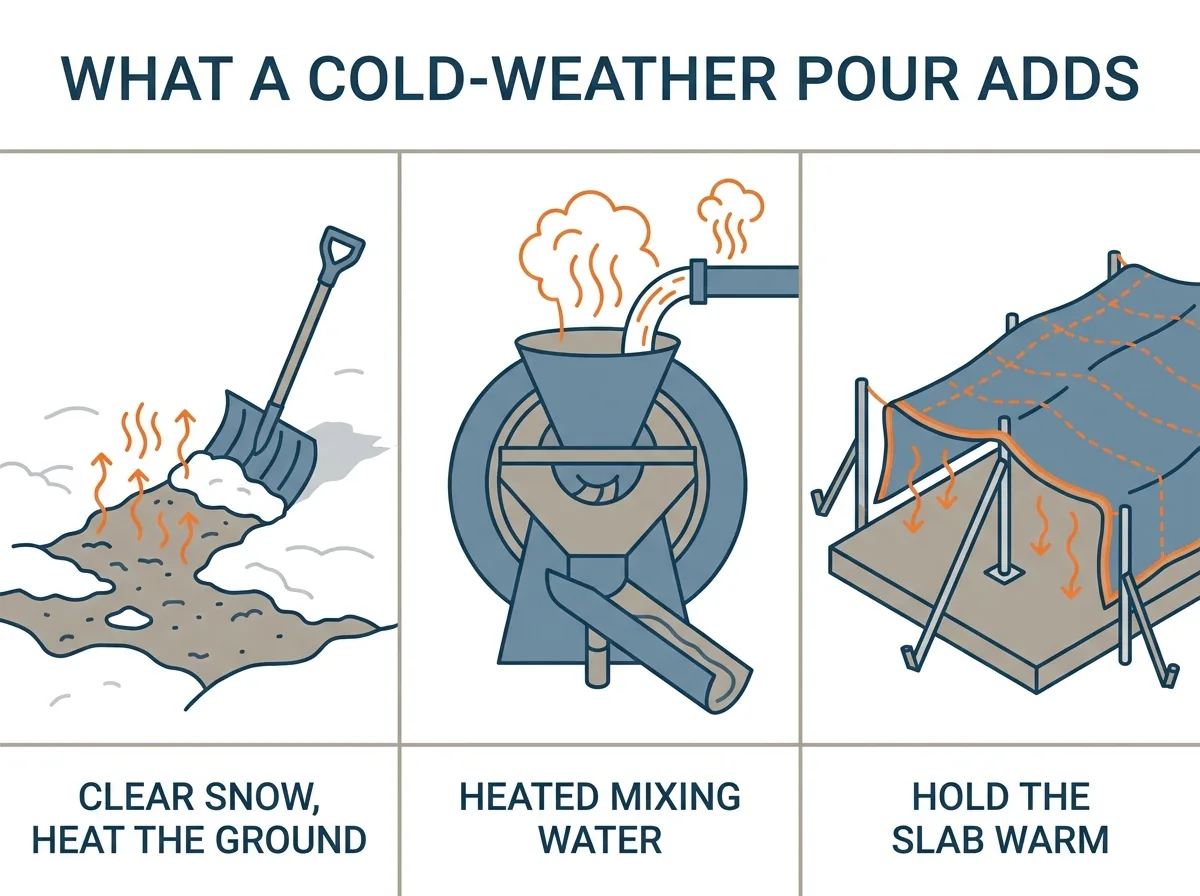
On site, the extra work is spelled out in the same RMCAO specification. All snow and ice has to come off the ground before the concrete goes down. The granular base underneath is pre-heated. Non-chloride accelerators, additives that speed the set without the chloride that corrodes reinforcement, go into the mix. Then the slab is held warm under heated enclosures, coverings or insulation. None of that is free. 2AZ Group totals the effect on the whole job rather than the concrete alone: a winter pour costs 15 to 25 percent more, for the heating, the accelerators, the insulated blankets and the hoarding, meaning a temporary heated enclosure built over the pour. That is for a result at best equal to a September pour.
The pour date is not the date you get your driveway back
This is the part that catches people who book late. The schedule after the truck leaves is longer than most homeowners plan for, and none of it is negotiable.
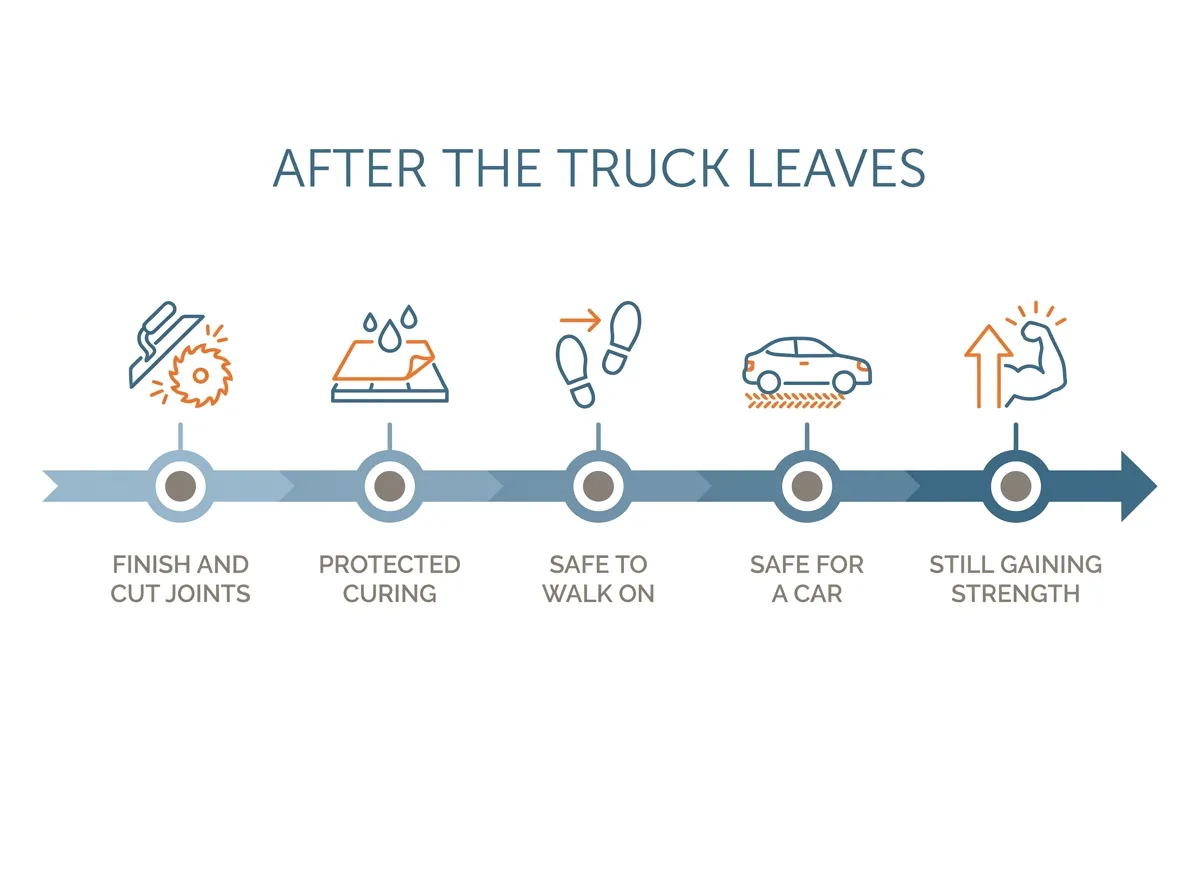
MCL Concrete in Milton lays the schedule out by day. At three days the slab is at roughly 50 to 60 percent of its potential strength and still not ready for a car. Seven days is the generally recommended minimum before driving a standard passenger vehicle on it, at around 70 percent of full strength. That milestone is in the standard as well as in the contractor's advice: RMCAO reproduces CSA A23.1 Table 19 as seven days total at ten degrees or more, and for however long it takes to reach 70 percent of the specified strength. Twenty-eight days is full curing time, when the slab can handle heavy vehicles, moving vans and garbage trucks. On a driveway that means arranging street parking for the best part of a week. Our concrete curing time chart sets out the milestones in order.
That schedule is what makes a late-October booking risky rather than merely tight. The pour may happen inside the good window while the first critical week of curing falls outside it. When a contractor pushes back on a date that looks fine on a calendar, this is usually what they are looking at.
There is one more thing the season decides: salt
A slab poured in late autumn meets its first winter within weeks. Petro Cement gives the early-autumn window partly for this reason: it leaves enough time to seal the surface before winter snow and salt arrive. ConcreteFinder's own driveway guidance is to keep de-icing salt off new concrete through that first winter, because salt accelerates spalling, the flaking away of the top surface, and a slab that has not fully hardened has the least resistance it will ever have.
A driveway poured in May has a full summer before it sees any salt. One poured in the last week of October does not, and that is a real constraint on how you get through the winter.
Our guide on what road salt does to Toronto concrete covers what that damage looks like and what each stage of putting it right costs.
How to book, and how far ahead
The useful move is to get quotes early and take a date in the middle of the season. Permits take longer than quotes do.
For anything touching the city boulevard, the sidewalk or a curb cut, this site's driveway research records, on JG Contracting's account of the Toronto rules, that a City of Toronto right-of-way construction permit is required and that street permits are issued only to licensed contractors rather than to homeowners. Confirm it with the city before you rely on it. That is lead time to add before the pour date, not after it. Our guide on driveway replacement permits and timing covers what is needed and when.
ConcreteFinder indexes 770 GTA concrete companies, 137 of them under concrete driveways. Three written quotes in hand well before the date you want is the version of this that works. Doing it in the last fortnight of October is the version that produces a winter surcharge.
- Book two to three months ahead of the season you want, which is Petro Cement's own advice.
- Avoid booking a pour in the last weeks of the window, since the first curing week may fall outside it.
- Ask whether the quote includes cold-weather protection, and what it adds if the date slips.
- Allow lead time for any right-of-way or permit approval before the pour date.
- Plan parking around roughly seven days before light vehicle traffic on a new driveway.
Frequently asked questions
When is the concrete season in Toronto?
Petro Cement names spring, April to June, and early autumn, September to October, as the best windows in Toronto. It marks winter off because frozen ground prevents proper pouring, and high summer because heat risks surface cracking unless drying is controlled. The trigger is temperature rather than the calendar. RMCAO, reproducing CSA A23.1, defines cold weather as a forecast air temperature below 5 degrees Celsius within 24 hours of placing, and from that point protection is required rather than optional.
Can concrete be poured in winter in Toronto?
It can. Petro Cement says concrete can be poured year-round with the right techniques and that reputable contractors use them. It costs more. Canada Building Materials charges $22.00 per cubic metre for winter handling from November 1 to April 30. 2AZ Group puts the surcharge at $20 to $40 per cubic metre from November through March, and the whole-job premium at 15 to 25 percent. RMCAO requires the concrete to be held at a minimum of 10 degrees Celsius for the whole curing period.
How long before I can drive on a new concrete driveway?
MCL Concrete puts the minimum at seven days for a regular car, at which point the concrete has typically reached around 70 percent of its full strength, and says to wait the full 28 days for heavier loads. That week of street parking is part of the job and worth planning for when the pour date is agreed.
Is it too late to pour concrete in October in the GTA?
Often it is tight rather than impossible. The pour itself may sit inside the good window while the first critical week of curing falls outside it, which is the part that matters. A contractor pushing back on a late-October date is usually looking at the curing week rather than the pour day.
How far ahead should I book concrete work in Toronto?
Petro Cement puts a number on it: book two to three months in advance to secure your preferred season, and it names spring as one of the busiest seasons for Toronto concrete contractors. Add to that the time to gather three written quotes, and the lead time on a right-of-way permit for anything touching the city boulevard or a curb cut, which only a licensed contractor can pull.
Sources
Every figure in this article is either counted from ConcreteFinder's own index of Greater Toronto Area concrete companies or copied from one of the pages below, which is named in the sentence that uses it.
- Canada Building Materials - GTA ready-mix price list (winter handling charge, November 1 to April 30)
- 2AZ Group - The Real Cost of Concrete Work in the GTA in 2026 (winter surcharges)
- Ready Mixed Concrete Association of Ontario - Cold Weather Concreting technical specification (2024), reproducing CSA A23.1:24 with CSA Group's permission
- Petro Cement, Mississauga - Best Time of Year to Pour Concrete in Toronto (the seasonal windows)
- MCL Concrete, Milton - How Long Does a Concrete Driveway Take to Cure (the day-by-day milestones)
Related reading
How ConcreteFinder is paid, and who wrote this
This guide was researched and written by the ConcreteFinder Research Team, published on September 17, 2026. Every figure above was re-opened at the page it came from on the day this went live, and each one names that source in the sentence that uses it. Every Greater Toronto Area concrete business on this site is listed free, and no company can pay for a position in the rankings or for a mention in an article. What ConcreteFinder does and does not charge for is set out on our page for contractors, and money is kept apart from the rankings on purpose. The ranking formula is published in full on our methodology page, and if a figure here is wrong we would rather hear about it, through contact.
Compare Greater Toronto Area concrete companies
No obligation. We match you with exclusive, local pros, so you compare and choose.