Polished Concrete in a Toronto Basement: Moisture First, Gloss Second
By ConcreteFinder Research TeamPublished 7 min read
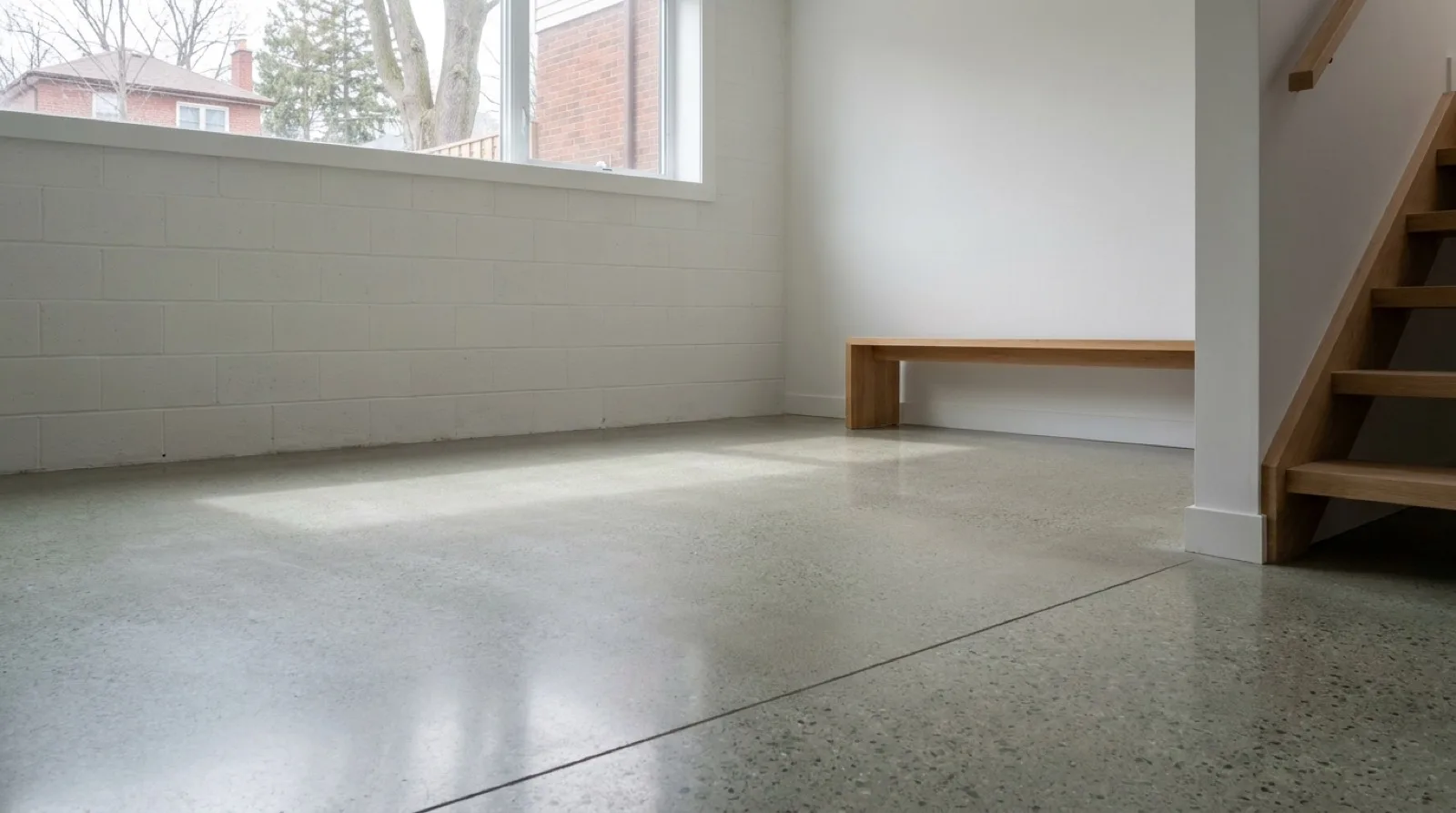
Polished concrete has an obvious appeal in a Toronto basement. The slab is already there, it is hard-wearing, it pairs well with in-floor heat, and it does not care about the humidity that ruins engineered wood down there. The catch is that the same slab is in direct contact with damp ground, and moisture moving up through it is the failure mode behind most floor finishes that lift, blister or go cloudy a year after installation.
So the order of operations matters more here than the choice of finish. This guide covers what has to be established before anyone runs a grinder, what the gloss levels actually mean in money, and the Toronto-specific rules, especially in condos, that decide whether the job is possible at all. The full sourced price table is in our polished concrete cost guide.
Moisture is the first question, not a detail
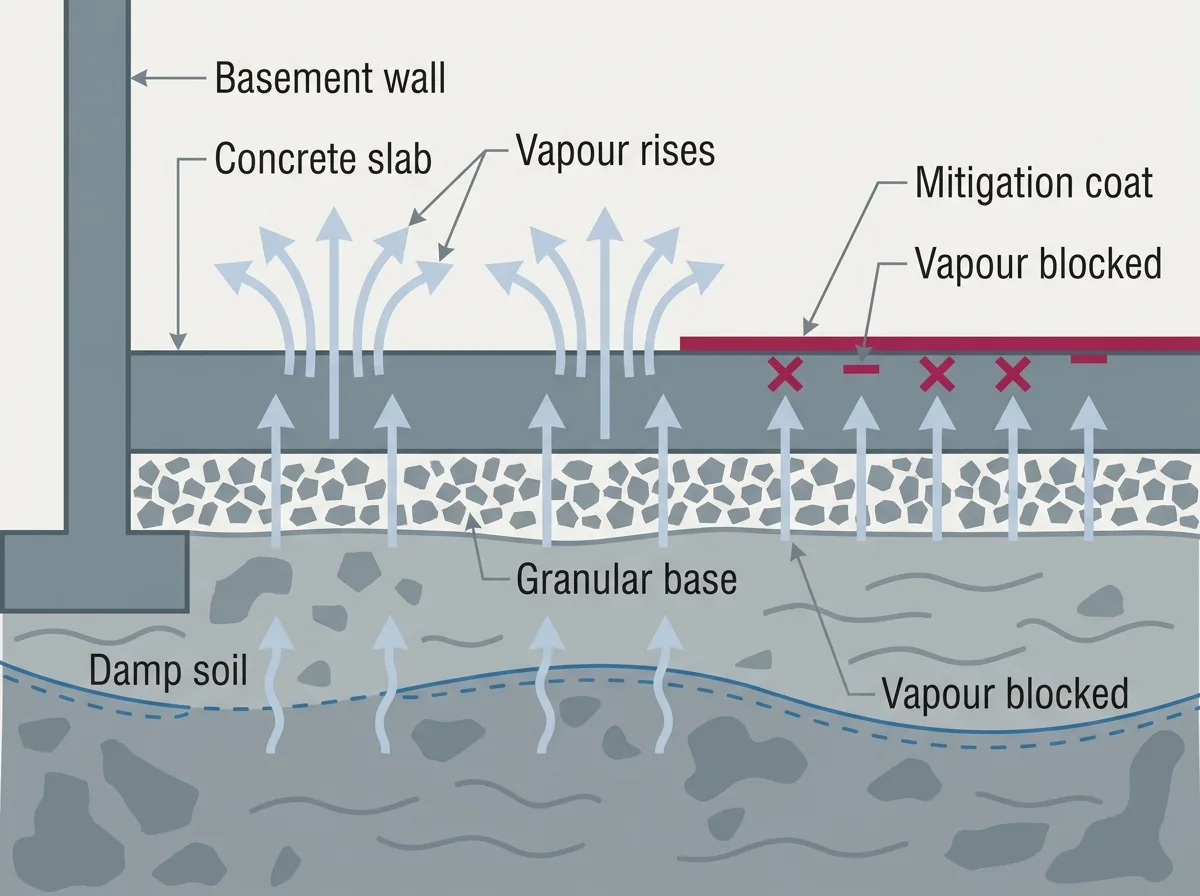
A basement slab sits on soil, and soil in the GTA is damp for most of the year. Water vapour moves up through the concrete continuously, and whether that matters depends entirely on what you put on top. A polished and densified surface breathes; a sealed or coated one may not.
Testing is cheap relative to the consequence. Surface Pro Epoxy puts moisture testing at $200 to $500, and where hydrostatic pressure is present, a moisture-vapour barrier runs $2.00 to $4.50 per square foot. That mitigation layer is a common GTA add-on rather than an exotic one, because snowmelt and road salt raise slab moisture and chloride content through the winter.
The practical rule is to insist the test happens and to see the result before choosing a finish. A contractor who quotes a coating for a basement slab without asking about moisture is quoting on hope. If the number comes back high, the honest options are mitigation, a more vapour-tolerant finish, or fixing the water problem first.
What the slab is in before anyone grinds it
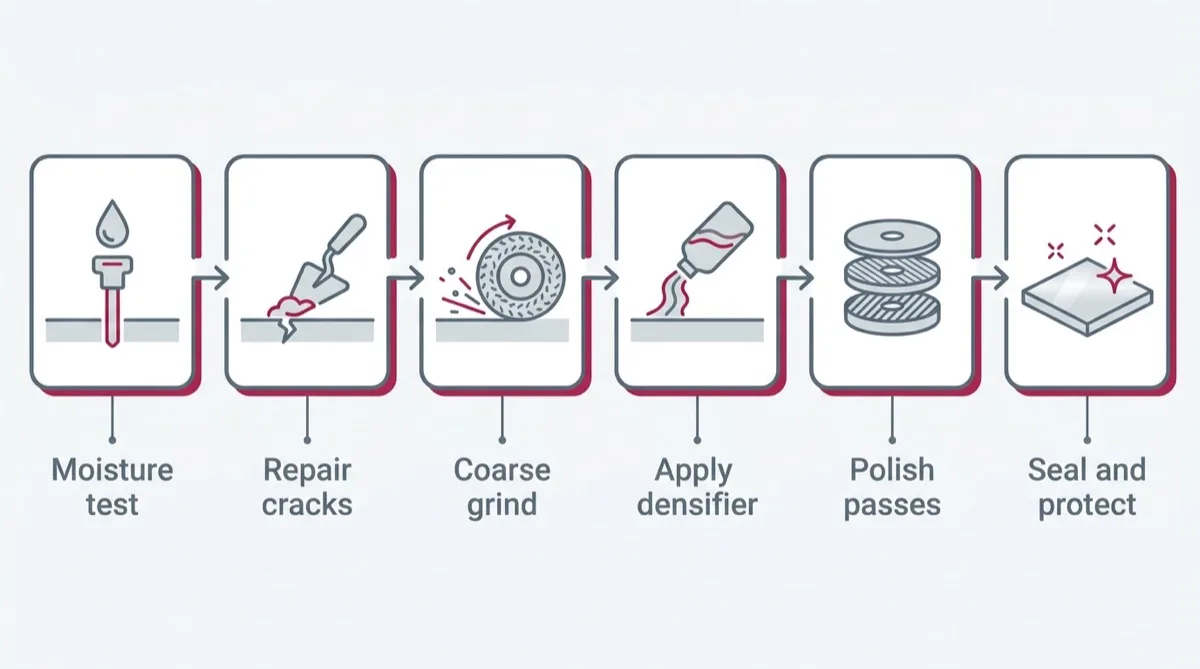
The second assessment is the condition of the concrete itself, because polishing exposes everything already in the slab rather than covering it. Cracks, patches, old adhesive and oil staining all become visible, and some of them become worse.
Repair is priced separately for that reason. Monarch prices minor crack repair at $250 to $800 and structural cracks at $1,000 or more, and Armour Guard pegs repair-heavy preparation at $1 to $5 per square foot on damaged existing concrete. Surface preparation and diamond grinding on residential jobs is $1 to $3 per square foot according to Monarch, driven by slab condition rather than by floor area alone.
Older GTA housing stock brings its own problem. Oil-saturated or spalled slabs in older homes need extra grinding and oil-stop primers, which is a real line item rather than a formality. Removing an old or failed coating is another, at $3 to $8 per square foot for residential work according to Monarch.
Gloss is the price lever
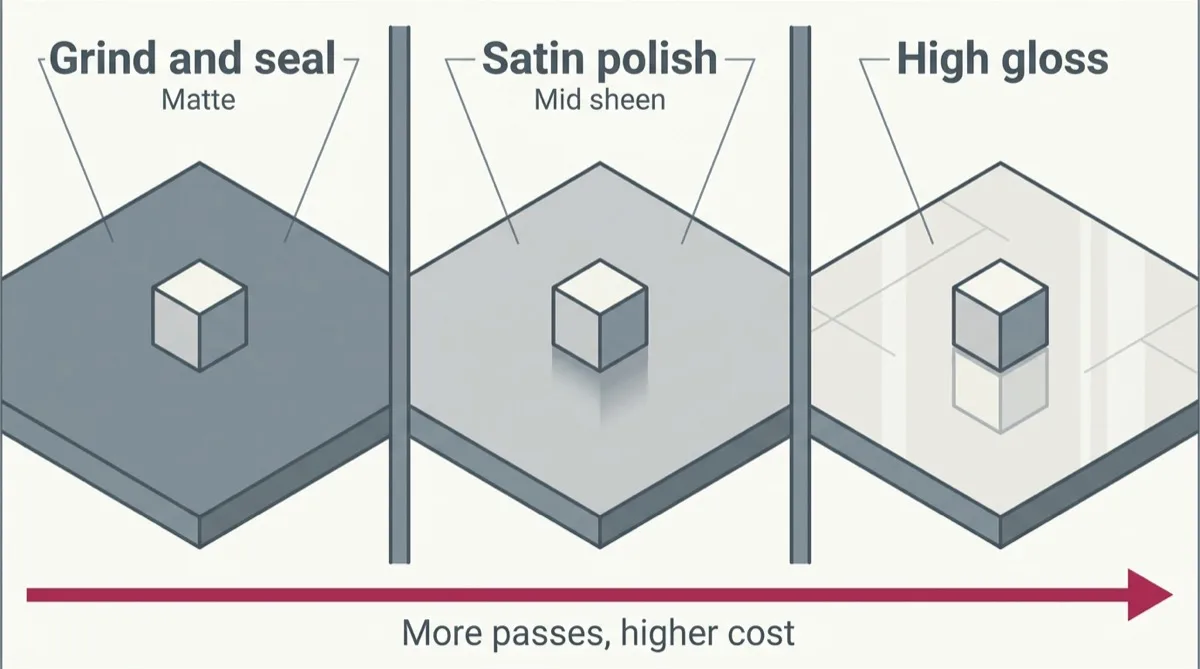
Once the slab is sound and dry enough, the number that moves is gloss, and gloss is really a count of grinding passes. Armour Guard tiers it explicitly: a basic grind and seal in a cream or matte finish runs $3 to $6 per square foot on an existing slab, a mid-sheen satin finish up to 800 grit runs $6 to $10, and a high-gloss finish at 1,500 to 3,000 grit or above runs $8 to $15.
For a Toronto residential job specifically, Toronto Epoxy publishes a typical installed rate of $5.50 to $7.00 per square foot, which sits in the satin band. Quotes on the same slab can legitimately span from $3 to $15 per square foot depending only on the finish chosen, which is why comparing two polished concrete quotes without knowing the target grit is comparing nothing.
Where the slab has to be poured as well as polished, the numbers change shape entirely. Armour Guard writes $10 to $25 or more per square foot where a new concrete pour is required, and that is open-ended at the top by the source's own wording.
Permits, condos and in-floor heat
Permits are the easy part. Polishing or coating an existing floor is interior finish work and needs no Toronto building permit. A permit and engineered drawings apply only where the structural slab itself is poured or replaced, which in a basement usually means a floor-lowering project, where the new slab falls under that project's own building permit.
Condos are the hard part, and this is where the job most often stops. Many Toronto condo boards require board approval for a flooring change and mandate acoustic underlayment for sound control, which Armour Guard prices at an added $1 to $3 per square foot. Polished concrete on suspended condo slabs is frequently restricted outright, so the board's rules are worth reading before getting quotes rather than after.
In-floor heat is a common pairing in this climate and a significant addition. Armour Guard puts hydronic in-floor heating with polished concrete at an added $6 to $12 per square foot. It has to be decided before the slab work rather than retrofitted, which puts it in the same category as moisture: a question for the planning stage.
- Interior polishing needs no Toronto building permit; a new or replaced structural slab does.
- Condo boards commonly require approval plus acoustic underlayment, adding $1 to $3 per sq ft, per Armour Guard.
- Hydronic in-floor heat adds $6 to $12 per sq ft, per Armour Guard, and must be planned before the floor work.
- Per-square-foot rates drop sharply above roughly 2,500 sq ft, so a small basement carries a mobilization minimum.
- HST at 13% applies on top of most quoted floor coating and polishing prices.
Polished concrete or a coating?
Polishing and coating are different answers to the same question, and in a basement the moisture result often decides between them rather than taste. Polishing grinds and densifies the existing slab so the finish is the concrete itself. A coating puts a new material on top, which means it can be specified for chemical resistance and colour but also that it can lift if vapour pushes underneath it.
For reference on the coating side, Canadian Concrete Surfaces puts a basement epoxy floor in Ontario at $3 to $7 per square foot, and notes that basement moisture drives the requirements. Monarch prices a solid-colour epoxy garage system at $5 to $8 per square foot and a polyaspartic one-day flake system at $7 to $12, with polyaspartic favoured in Toronto because it cures in cold weather and allows next-day use.
Our polished concrete against epoxy comparison works through that choice properly. ConcreteFinder lists 134 GTA companies under polished concrete and epoxy floors, scored on a published method with no paid placement.
Frequently asked questions
Does a basement slab need a moisture test before polishing?
It should have one. A basement slab sits on damp ground and water vapour moves up through it continuously, which is the failure mode behind coatings that blister or lift. Surface Pro Epoxy puts moisture testing at $200 to $500, and where hydrostatic pressure is present a moisture-vapour barrier runs $2.00 to $4.50 per square foot.
How much does polished concrete cost in Toronto?
It depends on the gloss level, because gloss is a count of grinding passes. Armour Guard tiers a basic grind and seal at $3 to $6 per square foot, a satin finish at $6 to $10 and a high gloss at $8 to $15. Toronto Epoxy publishes a typical residential installed rate of $5.50 to $7.00 per square foot, and HST applies on top.
Do I need a permit to polish a basement floor in Toronto?
No. Polishing or coating an existing floor is interior finish work and needs no building permit. A permit with engineered drawings applies only where the structural slab is poured or replaced, such as a basement floor-lowering project, where the new slab falls under that project's own permit.
Can I have polished concrete in a Toronto condo?
Often not, and the board decides rather than the contractor. Many Toronto condo boards require approval for a flooring change and mandate acoustic underlayment for sound control, which Armour Guard prices at an added $1 to $3 per square foot, and polished concrete on suspended condo slabs is frequently restricted outright. Read the board's rules before getting quotes.
Is polished concrete or epoxy better for a basement?
Moisture usually decides it. Polishing densifies the existing slab so the finish is the concrete itself and stays breathable; a coating adds a new material on top that can lift if vapour pushes underneath. Canadian Concrete Surfaces puts a basement epoxy floor in Ontario at $3 to $7 per square foot and notes that basement moisture drives the requirements either way.
Related reading
How ConcreteFinder is paid, and who wrote this
This guide was researched and written by the ConcreteFinder Research Team, published on August 20, 2026. Every figure above was re-opened at the page it came from on the day this went live, and each one names that source in the sentence that uses it. Every Greater Toronto Area concrete business on this site is listed free, and no company can pay for a position in the rankings or for a mention in an article. What ConcreteFinder does and does not charge for is set out on our page for contractors, and money is kept apart from the rankings on purpose. The ranking formula is published in full on our methodology page, and if a figure here is wrong we would rather hear about it, through contact.
Compare Greater Toronto Area concrete companies
No obligation. We match you with exclusive, local pros, so you compare and choose.